The New Hiring Math: When an AI Agent Replaces a Hire
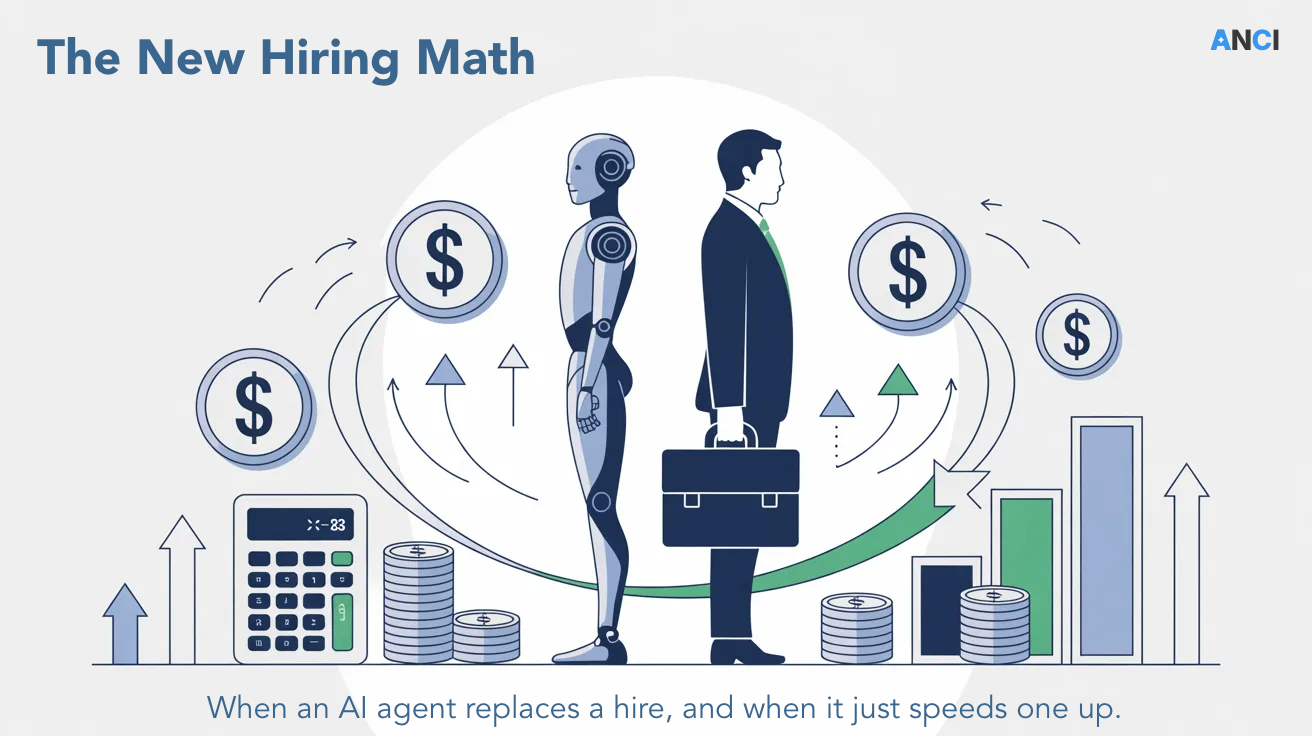
AI agents are priced by the task; hires are priced by the year. The new hiring math is about decomposing roles into components, not swapping people for software.

ANCI · AI Edge for Leaders · The Economics of AI
Every budget now carries a line that did not exist three years ago: agent spend. Beside it sits an older line under fresh pressure: headcount. And in every operating review, the same question surfaces — can the agent do this instead of hiring someone? Most leaders answer it at the wrong altitude. They set a salary next to a subscription, decide the subscription is cheaper, and move on. That comparison is almost always wrong, because a hire and an agent are not the same kind of thing. One is priced by the year. The other is priced by the task. The math only works once you see the difference.
The role was always a bundle
A job is not a unit of work. It is a container. When you write a job description, you bundle a dozen loosely related tasks into one package and hand it to one person — not because those tasks naturally belong together, but because hiring carries heavy fixed costs and you would rather pay them once.
Those costs are well documented. The fully loaded cost of an employee runs roughly 1.25 to 1.4 times base salary once payroll taxes, benefits, equipment, and overhead are added, and Bureau of Labor Statistics figures put benefits alone near 30 percent of total compensation. Recruiting a single hire averages around $4,700 before any work happens, and agency placement fees run 15 to 25 percent of first-year salary. A new hire is not productive on day one either. You are buying a ramp, not an output.
Because each of those costs attaches to the person and not to the task, the rational move has always been to load the person up. Give the analyst the modeling, the deck formatting, the meeting notes, and the data cleanup, because once you employ someone, the marginal cost of handing them one more task is close to zero. The role, in other words, is an abstraction layer sitting on top of the actual work. Agents break the logic underneath it, because they operate one layer down. An agent does not apply for the bundle. It executes a task. And pointing an agent at one more task is no longer a hiring decision — it is a usage decision.
Two cost curves that do not line up
A hire is a step function. You commit to a whole person at a fixed annual cost, and that cost barely moves whether the person runs at 60 percent utilization or 110 percent. You cannot buy 30 percent of an employee. The economics are lumpy by design, and most of the waste in any role hides in the gap between what you pay for and what you actually use.
An agent behaves more like a continuous curve. You pay per unit of work, and the units are small. Customer service agents in 2026 are priced from roughly ten cents per session to two dollars per conversation. Agents that chain together multi-step workflows cost more — often several hundred to several thousand dollars a month to operate — because every step spends tokens on reasoning, tool calls, and verification. The shape, though, stays the same: cost scales with use, not with a commitment.
Run the two against each other and the contrast is stark. A support team handling 60,000 conversations a year might cost two full-time agents at a fully loaded $70,000 each — $140,000 — whether the volume is steady or seasonal. An agent resolving the same 60,000 conversations at a dollar each costs $60,000. On the bulk of routine tickets, the agent wins by an order of magnitude. That single comparison is what launches most replacement decisions. The number is real. It is also the wrong number to decide on, because it describes only the easy middle of the distribution.
The danger lives in the tail. Klarna learned this in public. The company cut roughly 700 customer service roles, reported AI doing the work of hundreds of agents, then quality slipped on exactly the cases that mattered most. Complaints rose. The company began rehiring humans, with its CEO conceding that cost had become too dominant a factor. The agent priced the average beautifully and mispriced the tail at great expense. Replacement only works when the agent’s cost curve sits below the human’s across the entire distribution, tail included. For most roles, it does not.
Replace or speed up? The decision rule
An agent replaces a hire only when four conditions hold at once. The work is high volume, so per-task economics compound. The tasks are homogeneous, so one capability covers most of the distribution. The quality floor is forgiving, so a wrong answer is cheap to catch and fix. And the work carries thin judgment, so no human needs to own the outcome. First-line ticket triage, invoice matching, routine scheduling, first-draft data entry: these components genuinely collapse into software.
Notice that those conditions describe components, not jobs. Very few whole roles satisfy all four across every task they hold. What happens far more often is that the agent absorbs the repetitive components and the human keeps the judgment-bearing ones. That is a speed-up, not a replacement. A landmark study of 5,000 customer support agents found that an AI assistant raised issues resolved per hour by about 14 percent, with the biggest gains going to less experienced workers. A 2026 MIT and Johns Hopkins field experiment found that human-AI teams produced 50 percent more output per worker than human-only teams.
Most claims of replacement are speed-ups wearing a costume.
Speed-up is not automatic, and this is the part the optimistic case skips. A careful controlled trial by METR found that experienced open-source developers were 19 percent slower using early-2025 AI tools, even while they believed they were 20 percent faster. The felt acceleration ran ahead of the measured reality. Augmentation can lift throughput, flatten quality, and tax attention all at the same time. The roles that survive are the ones that own the tail and the judgment. You hire fewer people, and you hire them more senior.
Scheduling is a clean illustration. An agent that owns calendar coordination across teams does not replace the chief of staff, the recruiter, or the account executive whose calendars it manages. It dissolves a draining component scattered across many roles, so the residual human work gets denser and higher in leverage. At ANCI we watch this pattern repeat: our agent Zara does not vacate a seat — it removes a task that was never worth a seat to begin with.
How to actually budget for this
If the role is a bundle and replacement happens at the component level, headcount planning has to be rebuilt one layer down. Three moves matter.
First, decompose before you compare. Do not ask whether an agent can replace the analyst. Ask what the fifteen tasks the analyst performs are, and what the marginal agent cost of each one is. The unit of analysis is the task, never the title. Run the decomposition honestly and a $90,000 role often resolves into perhaps $15,000 of work an agent can carry and $75,000 of judgment that still needs a person — a very different decision than replace or keep.
Second, price the whole curve, and count the hidden costs. Agent operating costs are real and recurring. There is a validation tax: in one 2025 survey, 45 percent of developers said debugging AI-generated code took longer than writing it themselves — the human did not disappear, the human’s work shifted from producing to checking. And there is reversal cost, the price of rehiring and rebuilding when the strategy underperforms, which Klarna paid in full. A business case that books only the salary it removes and ignores these is not a business case, it is a wish.
Third, let headcount fall through architecture, not amputation. The companies handling this well are rarely firing a person directly into an agent. They decline to backfill as roles get lighter, they redirect freed capacity toward the judgment work agents cannot touch, and they protect the experienced people who hold institutional knowledge and own the hard tail. As Forrester puts it: AI takes over workflows and tasks, and workflows and tasks are not jobs.
The takeaway
The new hiring math is subtraction, but it happens at the task level, not the person level. An agent rarely replaces a hire outright, because a hire is a bundle and an agent is a component. It replaces pieces of jobs, and it only rolls up into a headcount decision when enough pieces of a single role collapse at once. The leaders who win the next two years will be the ones who stop reading the org chart as a list of people and start reading it as an architecture — a set of tasks, each with its own cost curve, waiting to be priced honestly. Read the role, not the headline.
Get AI scheduling insights, product news, and Bay Area community updates delivered to your inbox.
No spam. Unsubscribe anytime.