AI Agents Are Not a Breakthrough: The Final Layer of a 70-Year Stack
A layer-by-layer history of AI, from Turing to autonomous agents in 2026, showing how software, deep learning, and foundation models made agency possible. A collection of 56 Quotes by famous people on AI and Agents in the last 70 years.

The Agent Stack
A layer-by-layer history of AI, from Turing to autonomous agents in 2026, showing how software, deep learning, and foundation models made agency possible. A collection of 56 Quotes by famous people on AI and Agents in the last 70 years.
In 2026, AI agents schedule meetings, write and ship code, and run multi-step workflows inside enterprise systems with little supervision. The market keeps describing this as something that arrived suddenly. It did not. Agents sit at the top of a stack that has been built one layer at a time for seventy years. Each layer removed a single constraint. Remove the last one, and you get a system that does not just respond to work. It performs it.
Two lines capture the shift. Sam Altman predicted the first AI agents would join the workforce and materially change company output. Jensen Huang put it more bluntly, saying AI is going to eat software. The era of AI as a tool is closing. The era of AI as an actor has opened. To understand where agents can act, and where they cannot, you have to read the stack from the bottom.
Layer 01 · Foundations · 1950s to 1990s
Intelligence became computable
The first layer was an idea, not a product. Turing asked whether machines could think. McCarthy named the field and called it the science of making intelligent machines. The claim underneath both was radical for its time: intelligence could be formalized and computed. Nothing here shipped as an agent. What shipped was the premise that an agent could exist at all. Everything above this layer is an attempt to make that premise real.
Voices from the era
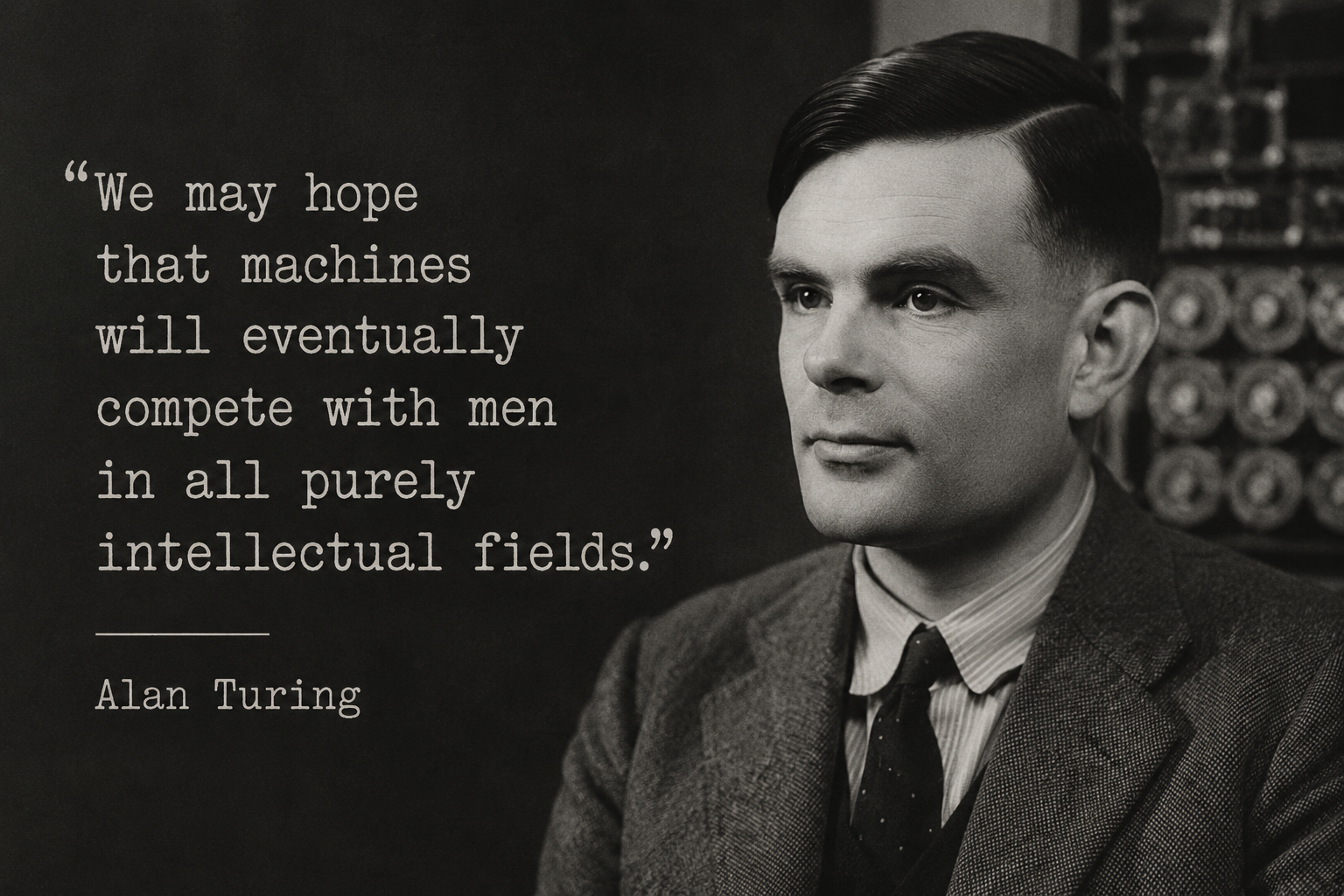
“We may hope that machines will eventually compete with men in all purely intellectual fields.”
Alan Turing
“Artificial intelligence is the science and engineering of making intelligent machines.”
John McCarthy
“Machines will be capable of doing any work a man can do.”
Herbert Simon
“We are not stuff that abides, but patterns that perpetuate themselves.”
Norbert Wiener
More voices from the era
“Will robots inherit the earth? Yes, but they will be our children.”
Marvin Minsky
“The first ultraintelligent machine is the last invention that man need ever make.”
I. J. Good
“I visualize a time when we will be to robots what dogs are to humans, and I’m rooting for the machines.”
Claude Shannon
“The question of whether a computer can think is no more interesting than the question of whether a submarine can swim.”
Edsger Dijkstra
“The ever accelerating progress of technology gives the appearance of approaching some essential singularity in the history of the race.”
John von Neumann, recalled by Stanislaw Ulam
Layer 02 · Software · 2000 to 2012
Work became software-defined
Agents need a world they can act inside, and the cloud and the internet built it. Industries turned into software: digitized, structured, API-driven. This is the substrate agents would later operate on, the period Marc Andreessen captured when he said software was eating the world. Without APIs and digital workflows there is nothing for an agent to touch. This layer did not make intelligence smarter. It made the world addressable, which is a different and equally necessary thing.
Voices from the era
“Software is eating the world.”
Marc Andreessen
“Automation applied to an efficient operation will magnify efficiency.”
Bill Gates
“It’s always Day 1.”
Jeff Bezos
More voices from the era
“Artificial intelligence would be the ultimate version of Google.”
Larry Page
“Every two days we create as much information as we did from the dawn of civilization up until 2003.”
Eric Schmidt
“Move fast and break things.”
Mark Zuckerberg
“The sexy job in the next ten years will be statisticians.”
Hal Varian
“A computer is the equivalent of a bicycle for our minds.”
Steve Jobs
Layer 03 · Deep Learning · 2012 to 2018
Intelligence became learned
The next constraint was rigidity. Hand-written rules could not generalize across messy, real inputs. Deep learning replaced rules with learning, building representations directly from data. Andrew Ng framed AI as a general input, the new electricity, rather than a single bolted-on feature. This is where behavior became flexible instead of brittle. Flexibility is the precondition for anything that has to operate in a changing environment, which is to say, the precondition for an agent.
Voices from the era
“We should stop training radiologists.”
Geoffrey Hinton
“Deep learning allows machines to learn representations from data.”
Yann LeCun
“AI is the new electricity.”
Andrew Ng
“Data is the new oil.”
Fei-Fei Li
More voices from the era
“Step one, solve intelligence; step two, use it to solve everything else.”
Demis Hassabis
“People worry that computers will get too smart and take over the world, but the real problem is that they’re too stupid and they’ve already taken over the world.”
Pedro Domingos
“Neural networks represent the beginning of a fundamental shift in how we develop software. They are Software 2.0.”
Andrej Karpathy
“Sheer brute force data analytics cuts the mustard just as well.”
Yoshua Bengio
“The brain sure as hell doesn’t work by somebody programming in rules.”
Geoffrey Hinton
Layer 04 · Foundation Models · 2018 to 2021
Intelligence became general
Until this point, each capability needed its own purpose-built system. Large models collapsed that. One model could write, summarize, translate, and reason in early forms, and it began showing abilities no one had explicitly programmed. Capability became reusable. A single foundation could power many tasks at once. This is the layer that made an agent economically plausible, because you no longer had to build and maintain a separate model for every job.
Voices from the era
“AI will be the most powerful technology humanity has created.”
Sam Altman
“We are seeing unexpected emergent abilities at scale.”
Ilya Sutskever
“We are moving toward systems that can use tools and act on behalf of users.”
Greg Brockman
“We are building systems that can learn like humans.”
Demis Hassabis
More voices from the era
“General methods that leverage computation are ultimately the most effective, and by a large margin.”
Richard Sutton
“A language model stitches together sequences of linguistic forms without any reference to meaning: a stochastic parrot.”
Emily Bender and Timnit Gebru
“Success would be the biggest event in human history, and perhaps the last event in human history.”
Stuart Russell
“If we get the dance between artificial intelligence and human society right, it would unquestionably be the single greatest achievement in human history.”
Kai-Fu Lee
“As we add more compute and training tasks, AI systems get predictably better at essentially every cognitive skill we can measure.”
Dario Amodei
Layer 05 · Copilots · 2021 to 2024
Intelligence became embedded
Capability moved into the workflow itself. Copilots sat inside the editor, the inbox, and the IDE. Satya Nadella’s framing, that every organization would have a copilot, marked the moment intelligence became ambient rather than separate. But copilots wait. They assist the human who initiates the action. This is the bridge layer: context awareness and human-AI collaboration loops are present, full autonomy is not yet.
Voices from the era
“Every organization will have a copilot.”
Satya Nadella
“The next generation of copilots will become proactive agents.”
Kevin Scott
“AI is a multiplier of human intent.”
Reid Hoffman
“Capability can increase very rapidly, and we must scale safety alongside it.”
Dario Amodei
“Models are becoming more general-purpose and capable of acting across domains.”
Mira Murati
More voices from the era
“AI is more profound than fire or electricity.”
Sundar Pichai
“The hottest new programming language is English.”
Andrej Karpathy
“ChatGPT is the iPhone moment of AI.”
Jensen Huang
“This is the most interesting year in human history, except for all future years.”
Sam Altman
“The development of AI is as fundamental as the creation of the microprocessor, the personal computer, the Internet, and the mobile phone.”
Bill Gates
Layer 06 · Agents · 2024 to 2026
Intelligence became actionable
The final constraint was initiative. Agents use tools, decompose goals into steps, take multi-step action, and operate with partial autonomy. The shift is small to describe and large in consequence: the system no longer only responds, it executes. Work becomes delegated and decomposed rather than hand-driven end to end. This is the layer we are standing on right now, and it is the first one where the software does the work instead of supporting it.
Voices from the era
“We may see the first AI agents join the workforce and materially change company output in 2025.”
Sam Altman
“AI is going to eat software.”
Jensen Huang
“Tool use is what makes models useful agents.”
Greg Brockman
“AI will be embedded in every workflow across the enterprise.”
Satya Nadella
“AI agents are already outperforming humans in many task domains.”
Marc Andreessen
“AI will become the operating layer of work itself.”
Mustafa Suleyman
More voices from the era
“AI agentic workflows will drive massive AI progress this year, perhaps even more than the next generation of foundation models.”
Andrew Ng
“Powerful AI is a country of geniuses in a datacenter.”
Dario Amodei
“This is the decade of agents.”
Andrej Karpathy
“We are in the foothills of the singularity.”
Demis Hassabis
“These agents are not tools. They are becoming collaborators.”
Marc Benioff
Each era removed one constraint. Agents are simply what is left when the last one is gone.
The stack, read as constraints removed
- Computable. Foundations, 1950s to 1990s
- Software-defined. Software era, 2000 to 2012
- Learned. Deep learning, 2012 to 2018
- General. Foundation models, 2018 to 2021
- Embedded. Copilots, 2021 to 2024
- Actionable. Agents, 2024 to 2026
What the stack tells you
Agents inherit every layer beneath them
Read top to bottom, the hype dissolves. Read bottom to top, the logic is clean. Computable, then software-defined, then learned, then general, then embedded, then actionable. Six constraints, removed in order, over seventy years.
The practical lesson for leaders is not that agents are magic. It is the opposite. An agent is only as capable as the APIs it can reach, the model it runs on, and the workflow it is embedded in. Treat it as a sudden arrival and you make bad bets. Treat it as the visible top of a long stack and you can see exactly where it will work, where it will fail, and what you still need to build underneath it.
For the first time, software does not just support work. It performs it. The companies that win the next decade will be the ones that understand which layer their problem actually lives on.
Read the full issue at anci.app/ezine.
Get AI scheduling insights, product news, and Bay Area community updates delivered to your inbox.
No spam. Unsubscribe anytime.