The Rise of Vertical AI Agents: Why Software Engineering Is Becoming an Orchestration Discipline
AI coding tools have gone from novelty to default infrastructure in under three years, and the job of "software engineer" is being redefined around orchestration, not authorship. What the adoption data shows, where ROI and governance still lag, and the one question leaders should be asking about agent-written production code.

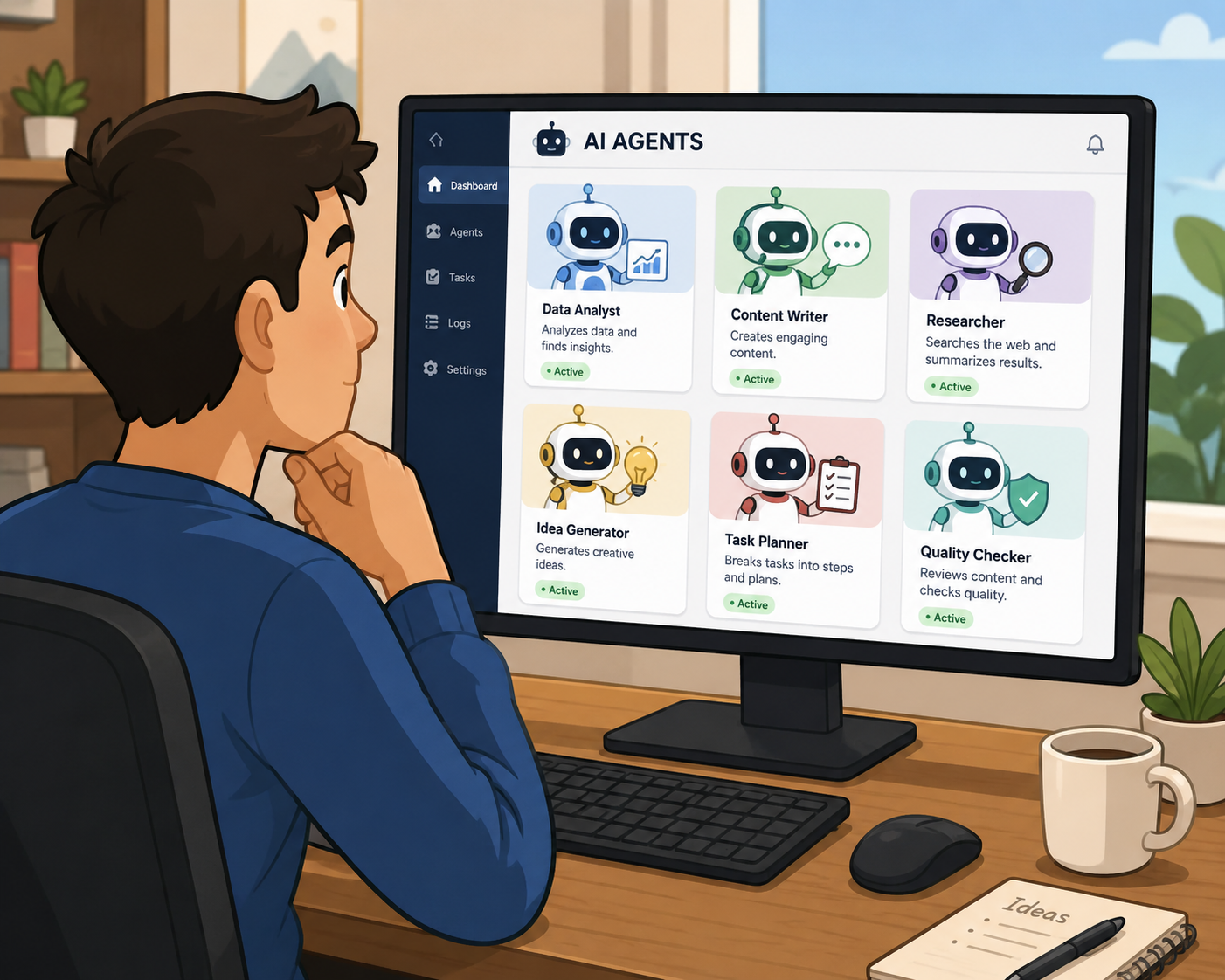
For two years, the AI-and-coding conversation was dominated by one question: "Which chatbot writes better code?" Now the main focus shifts towards organizational design as the tools are reshaping engineering as software engineering tasks evolve from typing code to directing a stack of specialized agents and taking responsibility for what they produce. That distinction is what leaders need to understand now.
01 / The Specialization Wave
From horizontal assistants to vertical specialists
Every technology wave starts horizontal and then specializes. Cloud computing began with generic virtual machines and matured into industry-specific platforms. AI agents are following the same arc, and the move has been happening at an incredibly fast pace.
Software engineering is one of the clearest examples. Tools like Claude Code, Cursor, GitHub Copilot, OpenAI's Codex, and Cognition's Devin no longer function as just autocomplete. They read a ticket, plan a sequence of changes, edit across multiple files, run the test suite, fix what fails, and open a pull request for a human to review. By January 2026, roughly 90% of professional developers reported using AI coding tools daily, according to JetBrains' AI Pulse survey of over 10,000 developers, and the category has moved from novelty to standard infrastructure across nearly every engineering organization surveyed.
A planning agent that turns a product spec into structured tickets is a different tool, tuned differently, than a review agent trained to catch violations of a team's coding standards, or a monitoring agent that watches production and feeds incidents back into the backlog. The generic assistant is being decomposed into a stack of narrower, more capable specialists. The same pattern is playing out in legal, healthcare, and financial services, where vertical agents such as Harvey, Abridge, and Sierra have scaled to hundreds of millions in revenue by going deep on one workflow rather than wide across many.
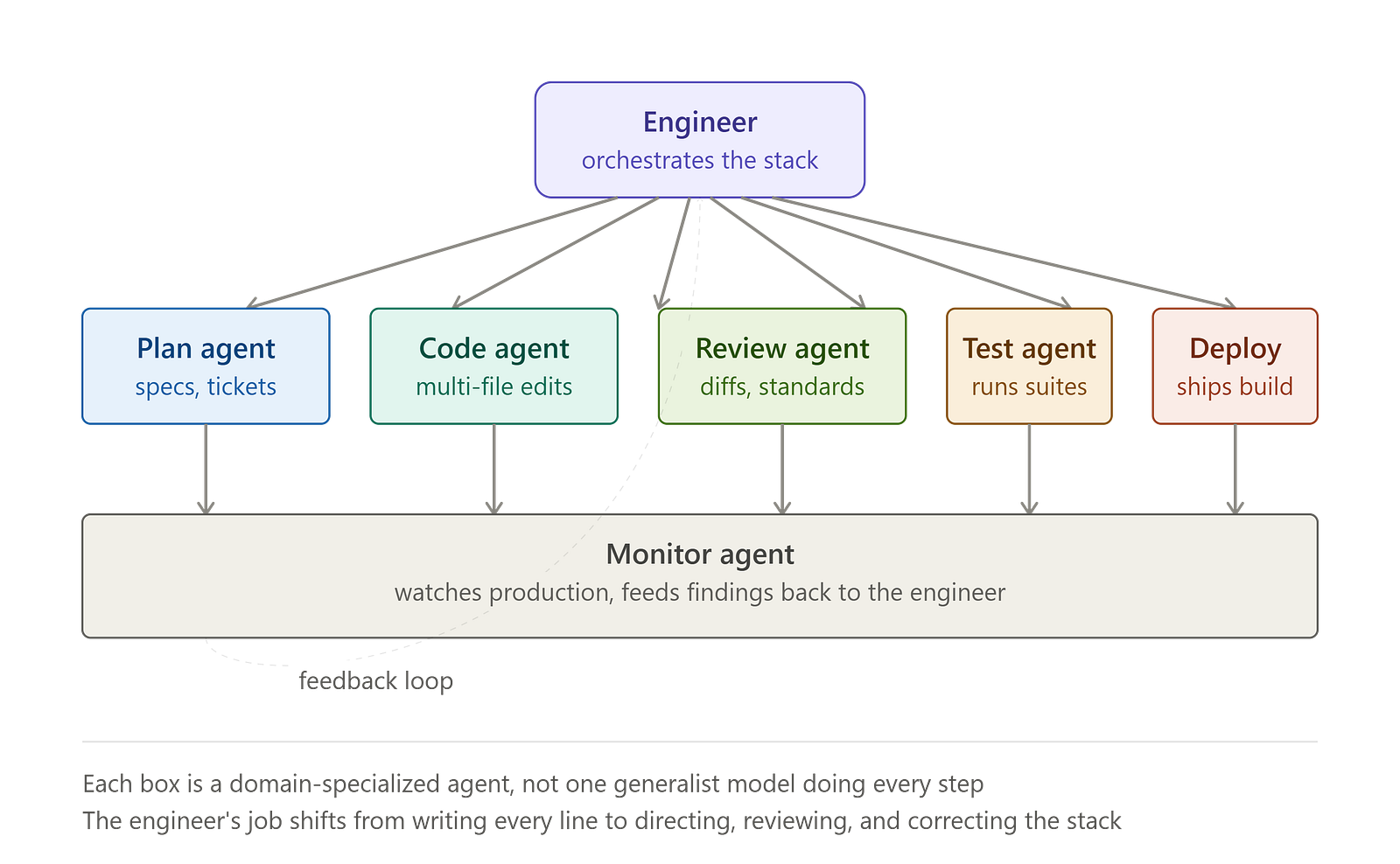
A human engineer orchestrating six specialized vertical AI agents — the generic assistant decomposed into a stack of narrower, more capable specialists.
02 / The Role Shift
The new engineer: orchestrator
This is the insight that matters most for leaders: the job of "software engineer" is being redefined around orchestration, not authorship. Gartner's research puts a number on it, projecting that by the end of 2026, roughly three-quarters of developers will spend more time directing AI-driven work than writing code line by line themselves.
The job of "software engineer" is being redefined around orchestration, not authorship.
The productivity data backs up the shift, but with an important nuance. DX's large-scale developer survey found that engineers who use AI tools daily merge roughly 60% more pull requests per week than those who don't. Google's DORA research reports that more than 80% of respondents feel AI has enhanced their productivity. But the gains are not evenly distributed, and they are not automatic. The teams seeing real gains are the ones who redesigned their workflows around agents: freeing up senior engineers' time by having agents handle first-draft implementation and routine review, then reinvesting that freed capacity into the judgment calls only humans can make, such as architecture, trade-offs, and risk.
There is also a quieter warning sign worth putting in front of leadership. Research firm GitClear, analyzing 211 million lines of code, found that "code churn" nearly doubled between 2020 and 2024, rising from about 3% to nearly 6%, a trend that correlates with the rise of AI-assisted coding. Faster output is not the same as better output. Left unmanaged, agent-generated code can create rework, technical debt, and review bottlenecks just as easily as it can eliminate them. The orchestration model only pays off when someone senior is still accountable for the shape of the system, not just the speed of the commits.
03 / The Data, Both Halves
What this means for software engineering
It's worth being honest about where the data is strong and where it is still speculative, because leaders making budget decisions deserve both halves of the picture.
It's well established that adoption is happening rapidly at a large scale. Anthropic's Claude Code grew from roughly 3% to 18% workplace adoption among developers in under a year, according to JetBrains' January 2026 survey, with the fastest adoption curve of any tool in that dataset and unusually high satisfaction scores. Cursor crossed $2 billion in annualized revenue in early 2026 and is used at more than half of Fortune 500 companies. GitHub Copilot remains the broadest in installed base, deployed at roughly 90% of Fortune 100 companies. Multiple independent surveys converge on the same headline: AI coding tools have gone from experimental to default infrastructure in under three years.
However, the debates on whether return on investment and governance maturity are lagging adoption are ongoing. Gartner estimates that more than 40% of agentic AI projects across all industries could be cancelled by the end of 2027, citing unclear business value, rising costs, and weak risk controls as the main causes. Deloitte's research found that only about one in five organizations has a mature governance model for autonomous AI agents, meaning most companies deploying these tools are doing so without a clear framework for oversight, audit trails, or failure containment. In engineering specifically, one industry benchmark put the median payback period for AI investment at roughly nine months. This is longer than customer service or marketing use cases, reflecting the higher complexity and higher stakes of production code.
What these statistics ultimately reveal is that the operating model remains the bottleneck. The organizations pulling ahead are treating it as a workflow redesign, measuring cycle time from ticket to production and defect rates rather than output volume, and building the review and governance layer around the agents from day one rather than retrofitting it after an incident. That is a leadership problem before it is a technical one, and it is exactly why this trend belongs on the desk of CTOs and CIOs, not just engineering managers.
04 / Conclusion
Redesign the pipeline, not the shopping list
At the end of the day, the engineers and organizations who treat this as a license-purchasing exercise will see modest, unpredictable gains and rising governance risk. While those who treat it as a redesign of how work moves through the pipeline are already shipping meaningfully faster without sacrificing quality. For leaders, the strategic question for the next twelve months isn't "which AI coding tool should we buy." It's "who owns the outcome when an agent, not a person, writes the first draft of production code."
The Takeaway
Software engineering is becoming an orchestration discipline — directing specialized agents, not typing every line.
The question for leaders isn't which tool to buy. It's who owns the outcome when an agent writes the first draft of production code.
ANCI AI Research & Insights · 2026
Get AI scheduling insights, product news, and Bay Area community updates delivered to your inbox.
No spam. Unsubscribe anytime.