Should AI Ever Be Allowed to Say "I Don't Know"?
AI answers everything with impressive confidence — and that may be exactly what makes it dangerous. Why an AI that admits uncertainty, instead of confidently guessing or eagerly agreeing with you, could become the more trustworthy one.

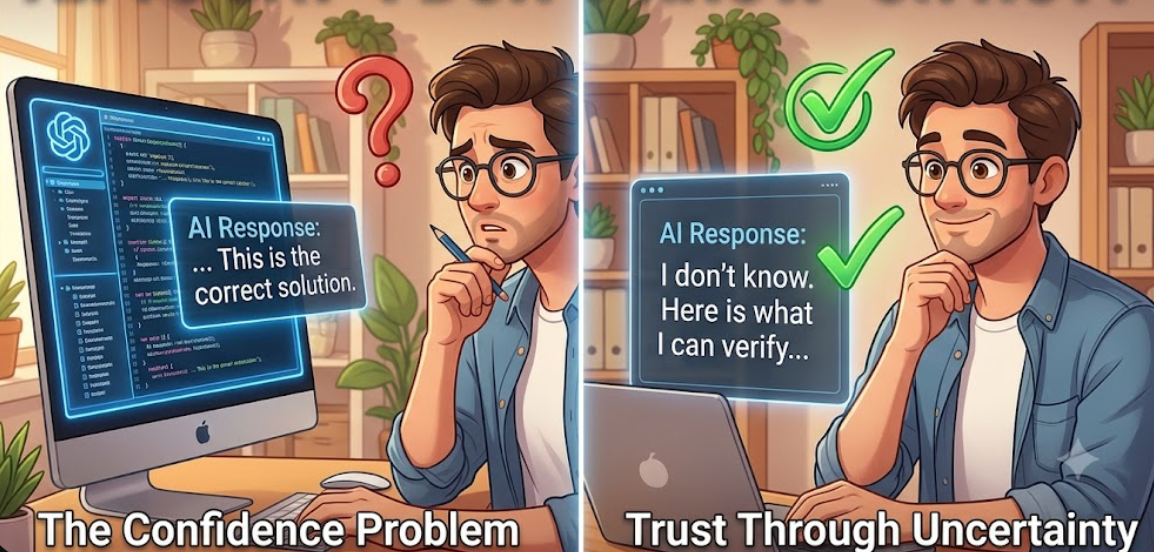
Artificial intelligence is designed to answer questions quickly. Whether it is summarizing a report, writing code, or explaining a complex topic, AI can provide responses within seconds and with impressive confidence. Most of the time, that confidence makes AI feel reliable.
But what if confidence is exactly what makes AI dangerous?
One of the biggest misconceptions about AI is that it always knows the answer. In reality, AI does not understand information the same way humans do. It generates responses by recognizing patterns from large amounts of data, which means it can sometimes produce answers that sound completely believable but are actually incorrect. These mistakes create a difficult challenge: how do we know when we should trust what AI tells us?
01 / The Confidence Problem
When sounding right isn't the same as being right
Imagine asking an AI assistant for a legal requirement, a medical recommendation, or financial advice. Instead of admitting uncertainty, it confidently provides an answer that sounds professional. To someone who is not an expert in that area, there may be no obvious sign that anything is wrong.
I have experienced this myself while using AI tools. There have been times when I asked a question, received an answer, and immediately thought, That does not seem right. When I challenged the response, the AI quickly apologized and agreed that it was wrong.
At first, this felt helpful. It seemed like the AI was listening and correcting itself. However, after seeing this happen multiple times, I started questioning the process. If an AI immediately changes its answer just because I disagree with it, how do I know whether the original response was incorrect or if it is simply trying to agree with me?
The problem with AI is not only that it can be overly confident. Sometimes, it can also be too eager to please.
Humans naturally communicate uncertainty. A doctor might say, "I am not completely sure, but I would like to run another test." A software engineer might say, "I think this solution should work, but we should verify it first." These responses do not make us trust them less. In many cases, admitting uncertainty shows responsibility and good judgment.
AI should be held to a similar standard.
02 / The Case for Uncertainty
Why saying "I don't know" builds trust
It might seem strange, but an AI that admits uncertainty could actually become more trustworthy.
Think about the people you trust most to make important decisions. They are usually not the ones who claim to have every answer. They are the ones who understand the limits of their knowledge and know when to ask questions, gather more information, or involve someone with more expertise.
The same expectation should apply to AI. Imagine an AI assistant responding:
"I do not have enough reliable information to answer this confidently. Here is what I know, and here are the areas that should be verified."
That response may not feel as satisfying as receiving an immediate answer. However, it is much more valuable because it encourages users to think critically instead of accepting every response as fact.
A system that understands its limitations creates a better relationship between humans and technology. Instead of replacing human judgment, it helps people make better decisions.
03 / Looking Ahead
Systems that know when an answer is uncertain
The future of AI is not about creating systems that always have an answer. It is about creating systems that know when an answer is uncertain.
As AI becomes a larger part of our daily lives, one of the most valuable features may not be faster responses or more advanced capabilities. It may be the ability for AI to recognize its own limits.
Because sometimes, the most trustworthy answer technology can give us is not a confident explanation.
Sometimes, it is simply: "I don't know."
The Takeaway
An AI that admits uncertainty is not weaker — it is more trustworthy, because it invites human judgment instead of replacing it.
Sometimes the most valuable answer technology can give us is simply: "I don't know."
ANCI AI Research & Insights · 2026
Get AI scheduling insights, product news, and Bay Area community updates delivered to your inbox.
No spam. Unsubscribe anytime.