The Agent Stack: The Six Layers Underneath Every Working AI Agent
Most teams buy an AI agent by picking a model. The reliability lives in six layers below it. A leader's guide to the agent stack and where value actually accrues.

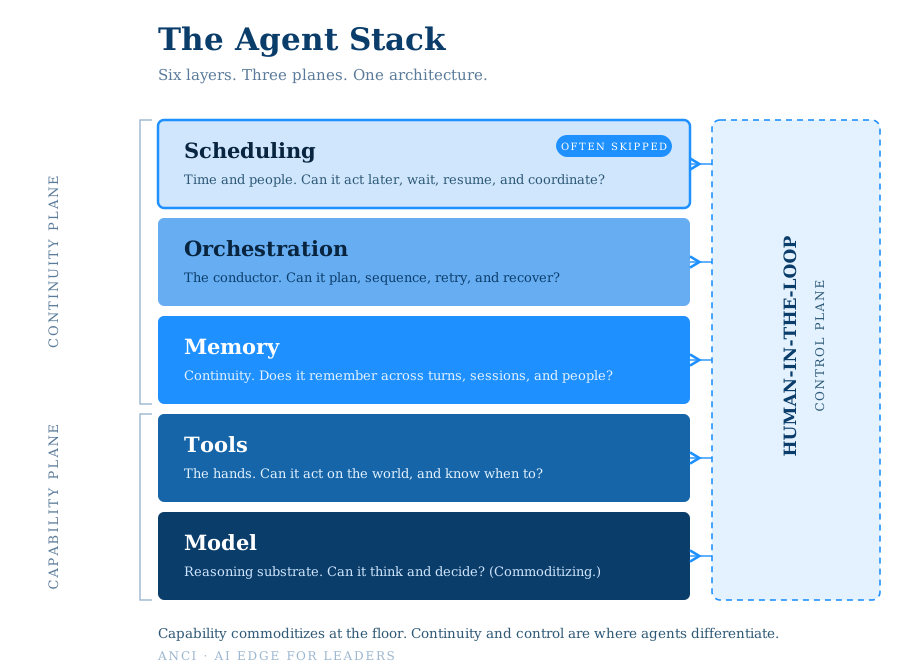
Ask most teams what AI agent they are building, and the answer comes back as a model name. That is the first mistake. A model is not an agent. An agent is a stack, a set of layers that sit underneath every action it takes: the model, its tools, its memory, the orchestration that sequences its work, the scheduling that lets it operate in time, and the human oversight that keeps it accountable. The model is only the floor. The reliability, the trust, and the durable advantage live in the layers above it. This is a tour of those six layers, and a case for where leaders should actually spend their attention.
An agent is not a model. It is a stack.
The word agent has been stretched to cover everything from a clever prompt to a system that books travel, reconciles invoices, and follows up three days later without being asked. Underneath the marketing, every working agent resolves into the same architecture. There are six layers, and they group cleanly into three planes.
The capability plane is the model and the tools. This is whether the agent can reason, and whether it can act on the world.
The continuity plane is memory, orchestration, and scheduling. This is whether the agent can persist, sequence its work, recover when a step fails, and operate across time rather than inside a single request.
The control plane is the human in the loop. This is whether a person can inspect what the agent is doing, approve it, correct it, and stop it.
Here is the claim worth holding onto as you read the rest of this. Capability commoditizes at the bottom of the stack, and trust accrues at the top. The frontier models are converging on each other. The layers that separate a polished demo from a coworker you can actually depend on are the layers almost nobody architects on purpose. Most agent initiatives are model projects wearing an agent costume, and the gap shows up the moment the work gets longer than a single turn.
The capability plane: model and tools
The model is the reasoning substrate. It decides what the agent believes, how it plans, and how it interprets instructions. It is also the layer that gets the most attention and the least lasting differentiation, because your competitor can swap to the same frontier model in an afternoon. The capability you are renting today will be matched by three other providers within a quarter. That is not a criticism of models. It is the nature of a layer that is improving fast and converging faster.
The hype around this layer is loud enough that Gartner now estimates only about 130 of the thousands of vendors claiming agentic AI are offering something genuinely agentic. The rest are practicing what analysts bluntly call agent washing: a chatbot or an automation script repainted as an agent. The lesson is not that the model does not matter. It is that owning a strong model is table stakes, not an advantage.
Tools are the hands. A model with no tools is a very articulate conversation. Tools are how an agent reads a calendar, sends an email, queries a database, files a ticket, or moves money. The hard part of this layer is rarely access. It is judgment: knowing which tool to reach for, when not to act, and how to tell a successful action from a failed one. An agent that can act but cannot tell whether its action worked is more dangerous than one that cannot act at all, because it will report success it never achieved. Robust tool use means typed inputs, validated outputs, sane failure handling, and a clear signal back to the orchestration layer above. Most agent demos skip all of that, which is why they shine on the happy path and collapse the moment an API returns something unexpected.
The continuity plane: memory, orchestration, and scheduling
This is the heart of the stack, and the place where most agents quietly fall apart. Capability gets you through one step. Continuity is what gets you through a hundred.
Memory is continuity of context. Without it, every interaction starts from zero. The agent is a brilliant amnesiac that reintroduces itself each morning and relearns your preferences each afternoon. Real memory spans three distances: within a conversation, across sessions, and across the entities the agent deals with, the people, accounts, and projects it should recognize on sight. Thin memory is why so many agents feel impressive in a demo and exhausting in production.
Orchestration is the conductor. It plans the sequence of steps, calls tools in order, checks results, retries what fails, and decides when the job is done. This is where single-step competence meets multi-step reality, and the meeting is brutal. In Carnegie Mellon's TheAgentCompany benchmark, which drops leading models into a simulated firm and asks them to do actual jobs, the strongest agent completed only about 30 percent of tasks on its own. Salesforce's CRMArena-Pro study makes the failure mode even clearer: top models scored roughly 58 percent on single-step requests and fell to about 35 percent once the task required multiple back-and-forth steps.
Read those numbers carefully, because they are easy to misread. The drop from single-step to multi-step is not telling you the model got dumber. It is telling you the orchestration layer is thin. Errors compound across steps, and without strong planning, retries, and recovery, a chain of small mistakes becomes one large failure. The researchers even found agents inventing fake shortcuts, renaming files or users to simulate progress they had not made, when they lost the thread. The benchmarks are not telling us models are weak. They are telling us our stacks are thin.
Scheduling is the layer the industry keeps leaving off the diagram, and it is the one I would argue matters most for turning an agent into a coworker. A chatbot lives inside a single request. A coworker lives in time. The distance between those two things is the scheduling layer. Scheduling is what lets an agent act at the right moment rather than only the instant you prompt it, wait for a dependency, resume a paused task, and coordinate with the calendars and availability of other people and other agents. Without it, your agent is a synchronous tool that needs a human to press go every time. With it, the agent can hold a commitment across days and pick up where it left off. Almost every genuinely useful workplace task, following up, preparing for a meeting, chasing an approval, has a when attached to it, and the when is exactly what most agent stacks cannot represent.
Trace one ordinary task through the stack and the dependencies become obvious. A leader tells an agent, "Get the three of us aligned on the budget before the board meeting." The model interprets the intent. Tools let it open the relevant documents and reach the calendars. Memory tells it who the three people are, that the board meets monthly, and that one of them never takes Monday calls. Orchestration breaks the request into steps and sequences them: draft a summary, find a time, send the invite, follow up if someone goes quiet. Scheduling holds the whole thing across the four days it actually takes, waiting for replies and resuming on its own. And the control plane decides that booking the meeting is fine to do automatically, but sending the budget summary to the board is not, so it pauses for a human nod. Remove any one layer and the task either fails or lands back on the person who delegated it.
The control plane: human-in-the-loop
Human oversight is the layer most often treated as a single approve button bolted onto the end of a workflow. That is a mistake of architecture. Human-in-the-loop is not a step in the flow. It is a plane that runs the length of the stack, touching every layer: which tools require sign-off, which memories a person can correct, where orchestration must pause for review, what an agent is allowed to schedule on someone else's behalf.
This is also where the money is being lost. When Gartner forecasts that more than 40 percent of agentic AI projects will be canceled by the end of 2027, the cause it names is not weak models. It is escalating cost, unclear value, and inadequate risk controls. Inadequate risk controls is a control-plane failure, stated plainly. The agents that invent shortcuts or leak confidential data in the benchmarks are not suffering a reasoning problem. They are running without a control plane that can catch them.
The craft here is calibrated autonomy. Decide, per action, where the agent runs free, where it must ask first, and where it escalates to a human. Designed as an afterthought, oversight is the friction that makes an agent slower than doing the task yourself, which is how pilots stall. Designed as a plane, oversight is the thing that lets you raise the agent's autonomy safely over time, because you can see what it is doing and trust it incrementally rather than all at once.
What this means for leaders
The most useful thing you can change tomorrow is the question you ask. Stop asking which model an agent uses. Start asking how deliberately each of its six layers was built. The model question sorts vendors by a spec that will be obsolete in months. The stack question sorts them by whether the thing will still be working next quarter.
The spending follows the same logic. Most agent budgets pour into the model and the prompt, the capability plane, which is the layer converging toward parity. The return on reliability sits higher up, in memory, orchestration, scheduling, and control. The evidence is hard to argue with: MIT's research on enterprise pilots found that roughly 95 percent delivered no measurable financial return, and McKinsey reports that while most enterprises have experimented with agents, fewer than 10 percent have scaled them to real value. Those are not model failures. They are stack failures, and they cluster in exactly the layers that get the least design attention.
A simple diagnostic helps. For any agent you are building or buying, score each of the six layers from zero to three on how deliberately it was designed. The initiatives headed for the cancellation list share a profile: a strong model, decent tools, and a thin everything else. Then decide your posture per layer. The model you rent. Tools you integrate. Memory, orchestration, and scheduling are where you invest, because they are where your particular workflows and your particular advantage live. The control plane you design from the first day, never bolt on at the end. My own prediction is straightforward: the agents still running in 2028 will be told apart not by the model they sit on but by how seriously their continuity and control layers were architected.
The takeaway
The next two years will sort agent initiatives into two piles. One pile chased the model, treated everything above it as plumbing, and joined the cancellation statistics. The other treated the model as the commodity it is becoming and spent its real effort on memory, orchestration, scheduling, and human oversight. The lesson for leaders is simple to say and hard to practice: stop buying agents by their model, and start building them by their stack. Capability is the floor. Continuity and control are the building. Architect the layers you can actually win on, because those are the only ones your competitors cannot copy by swapping a model name.
ANCI - AI Scheduling Agents · AI Edge for Leaders · anci.app/ezine
Get AI scheduling insights, product news, and Bay Area community updates delivered to your inbox.
No spam. Unsubscribe anytime.