When Design Fails, Why Do We Blame Ourselves?
A door that says PUSH but begs to be pulled, a thermostat that will not cool faster at 60 degrees — when products confuse us, we blame ourselves. But the real culprit is often a design that fights our mental models instead of working with them.

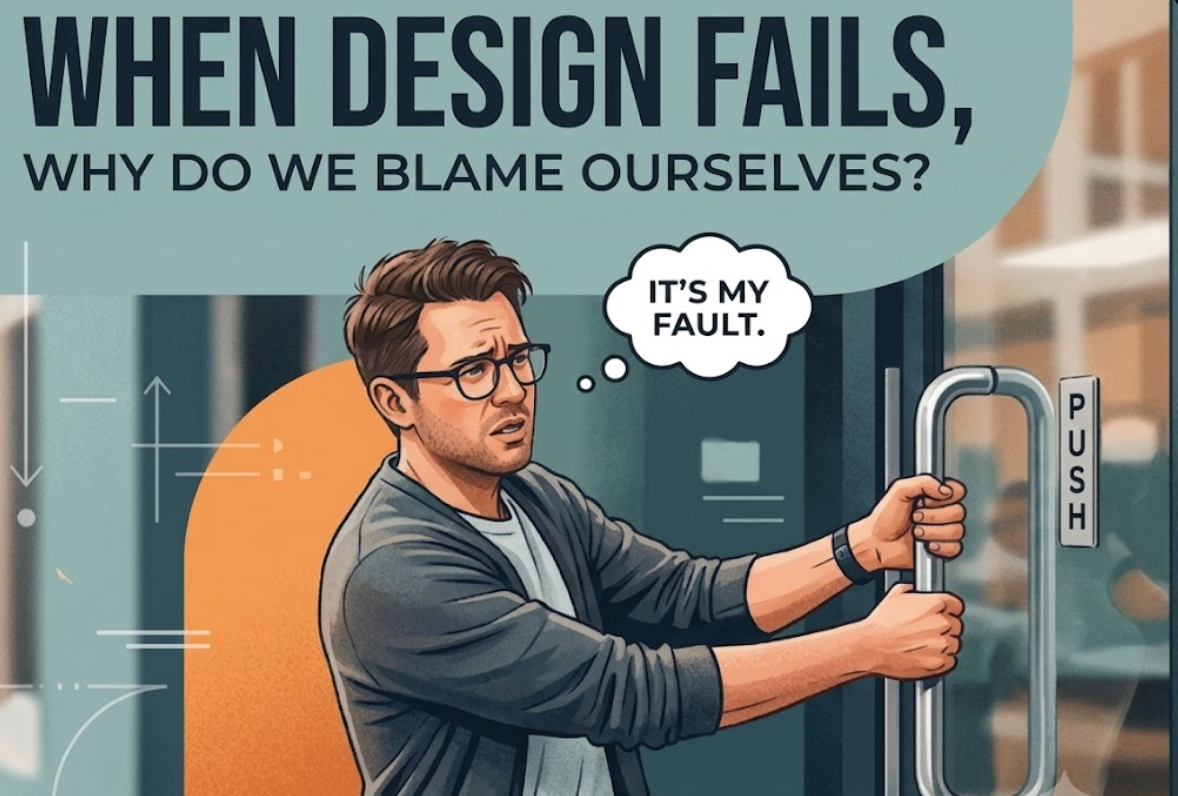
A few weeks ago, I went to a coffee shop with my friends. When we walked up to the entrance, I reached out and grabbed the large vertical bar on the glass door and tried pulling it open. The door did not move.
I was confused, so I tried the other door next to it. The same thing happened. After a few seconds, someone inside the coffee shop sighed and pulled the door open for us. That was when I noticed the sign that said "PUSH."
At first, I thought, I can't believe I missed the sign.
But after thinking about it more, I realized the door itself was giving me the wrong message. The large bar on the outside looked exactly like something designed to be pulled. Even though the sign told me what to do, the design created a stronger expectation.
The problem was not that I failed to read the sign. The problem was that the design encouraged me to make the wrong assumption.
This experience made me realize that design influences our actions more than we often notice. Sometimes, when something feels confusing, it is not because we are using it incorrectly. It is because the design is not communicating clearly.
01 / The Role of Mental Models
The predictions we make before we ever touch a thing
These expectations we create are called mental models.
A mental model is the idea we have in our minds about how something should work. It is the prediction we make before interacting with an object, system, or product.
These models come from our past experiences. If we have opened hundreds of doors with handles, our brain automatically connects a handle with pulling. We do not stop and analyze every door because we already understand how we expect it to work.
The same thing happens with digital products. We learn that a magnifying glass usually means search, a trash can usually means delete, and a button usually means clicking it will trigger an action.
When a design matches our mental model, the experience feels natural. We do not have to think about every step because the product works the way we expect.
But when a design goes against our expectations, that is when frustration happens.
02 / When Our Mental Models Are Wrong
Why turning the thermostat lower doesn't cool the room faster
Sometimes, our mental models can also cause us to misunderstand how something works.
Imagine it is a very hot day and you want to cool your house down as quickly as possible. You set your thermostat to 70 degrees, but you are still uncomfortable. Would setting it to 60 degrees make it cool faster?
Many people would say yes because we naturally think of temperature controls like a gas pedal. More input should create more output.
However, most thermostats do not work that way. The air conditioner is either running or it is not. Setting the temperature lower does not make the AC produce colder air. It simply makes the system continue running after the room has already reached the temperature you wanted.
The reason this feels surprising is because our mental model does not match the actual system.
This is an important lesson for designers: it is not enough to create something that works technically. A product also needs to make sense from the user's perspective.
03 / Designing for People, Not Just Features
More features or more simplicity? It depends on who you ask
Another challenge in design is deciding how many features a product should have.
A product with more features can provide more functionality, but it can also become more complicated. A simpler product may be easier to use, but it may not provide enough control for certain users.
So which approach is better? It depends on who the product is designed for.
A professional photographer may prefer a camera with hundreds of settings because they need control over every detail. However, someone who just wants to take pictures with their family may prefer a camera that is simple and straightforward.
Neither design is better. They are designed for different people.
Good design starts by understanding the user. There is no perfect product that works for everyone because different people have different needs.
04 / Why User-Centered Design Matters
The best remote is the one that works for that person
Imagine designing a television remote for a 90-year-old woman.
Would you include every possible button? Probably not. You might make the buttons larger, remove unnecessary features, increase contrast, and make the most important actions easier to find.
The goal is not to create the most advanced remote. The goal is to create the remote that works best for that person.
Good design is not about making products more complicated. It is about making interactions easier and reducing unnecessary frustration.
05 / Looking Ahead
The best designs go unnoticed
Design shapes almost every interaction we have, from opening a door to using an application.
The best designs often go unnoticed because they work naturally with the way we think. They guide us, communicate clearly, and make the correct action feel obvious.
But when something feels confusing, the problem is not always the person using it. Sometimes, the design itself needs to improve.
So the next time you struggle with a product or technology, do not immediately blame yourself. Start noticing the design. Because good designs do not force people to adapt to the system. Good designs adapt to people.
The Takeaway
When something feels confusing, the problem is not always the person using it — sometimes the design itself needs to improve.
Good designs do not force people to adapt to the system. Good designs adapt to people.
ANCI AI Research & Insights · 2026
Get AI scheduling insights, product news, and Bay Area community updates delivered to your inbox.
No spam. Unsubscribe anytime.