The AI Agent Race Is Moving From Smarter Models to Better Context
As AI becomes more capable, having the right context is becoming just as important. Why the next AI race may not be about building smarter models, but about building AI that understands the data, workflows, and rules of the business it works in — and why vertical, specialized agents may win.

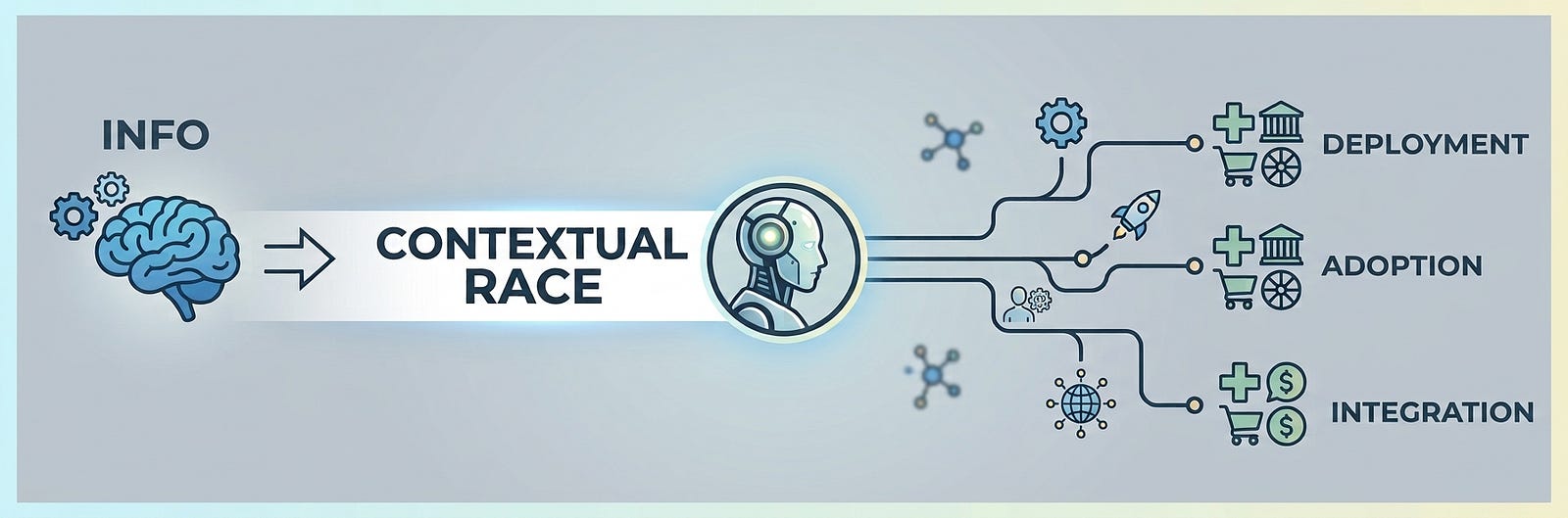
AI has spent the last few years getting smarter. Every new model seems to be better at reasoning, coding, writing, and answering questions. But as AI agents become capable of actually doing work, being smarter may not be enough.
An AI agent can be extremely intelligent and still be bad at its job if it does not understand the environment it is working in.
Imagine asking an AI to help a hospital manage patient appointments. Knowing how to write an email or answer a question is not enough. The AI would also need to understand the hospital's scheduling system, policies, patient information, and when it should ask a human for help.
This is why the next AI race may not just be about building smarter models. It may be about building AI that understands more context.
01 / The Comparison Trap
Smarter does not always mean more useful
When people compare AI models, they often focus on how intelligent they are.
Which model is better at reasoning? Which one writes better code? Which one gets the highest score on a benchmark?
These things matter. But they do not tell the whole story.
Imagine two employees are given the same task. One is extremely intelligent but knows almost nothing about your company. The other may not be as intelligent, but has spent years learning your company's products, customers, policies, and systems.
Who would you trust more to get the job done?
In many situations, it would probably be the second person.
AI agents face the same problem.
A powerful AI model can give a great answer, but that answer is only useful if it has the right information behind it. An AI agent working for a bank needs to understand financial rules and company policies. An agent working for a hospital needs to understand medical information and patient privacy. An agent working for a manufacturer needs to understand equipment, inventory, and production processes.
The model does not necessarily need to know everything. It needs to know what matters for the job.
02 / Specialization
This is where vertical AI comes in
This is one reason vertical AI agents are becoming so interesting.
Instead of creating an AI agent that tries to work across every industry, companies can build agents specifically for one industry or type of work.
For example, a general AI could answer a customer's question about returning a product.
A specialized retail agent could do much more. It could look up the customer's order, check the company's return policy, determine whether the purchase qualifies, start the return, and update the system.
The difference is not necessarily that the second AI is smarter. It has better context.
This is already becoming a major focus for businesses. Deloitte's 2026 research found that 85% of surveyed organizations expect to customize AI agents for the specific needs of their businesses. The research also found that companies are exploring agents for areas such as customer service, supply chains, cybersecurity, and knowledge management.
This suggests that businesses may not be looking for one AI that can do everything. They are looking for AI that can do one thing really well.
03 / Beyond Data
Context is more than just data
However, giving an AI access to company data does not automatically make it useful.
An AI agent also needs to understand how that company works.
For example, imagine an AI agent working in a finance department. It might have access to financial records, but that does not mean it should be allowed to make every financial decision.
It needs to know which decisions require approval. It needs to understand company policies. It needs to know which information it can access and which actions it is allowed to take.
This becomes even more important when AI agents can actually take action instead of just giving recommendations.
If an AI makes a mistake in an answer, a person can ignore it.
If an AI makes a mistake while sending money, changing a customer's account, or making an important business decision, the consequences can be much bigger.
Deloitte's 2026 research found that only 21% of surveyed organizations had mature governance models for agentic AI.
As companies give AI more control, they also need better systems for controlling it. The smarter the agent becomes, the more important it is to know what it should and should not be allowed to do.
04 / The Real Advantage
The AI model may not be the biggest advantage
This could change how companies think about AI. Right now, there is a lot of attention on which AI model is the best. Companies compare models based on speed, reasoning, accuracy, and other capabilities.
But if many companies have access to similar powerful models, the model itself may not be what gives a company the biggest advantage. The advantage could come from everything around it.
A company's internal data, workflows, customer information, software systems, industry knowledge, and processes can make an AI agent much more useful.
Think of the AI model as the brain. The context is what tells that brain what it is looking at, what it is supposed to do, and what rules it needs to follow. This is also why vertical AI could become so important.
A company that deeply understands one industry may be able to create a better AI agent for that industry than a company trying to build an AI for everyone.
A healthcare agent does not need to know how to run a restaurant. A restaurant management agent does not need to understand how to process a mortgage. The best AI for a specific job may be the one that understands that job the best.
05 / What Comes Next
The future of AI may be more specialized
For a long time, the idea of AI has been centered around creating one system that can do almost everything.
But the future might look very different. Instead of one AI doing every job, companies could have many specialized AI agents working across different parts of the business. One agent could handle customer support. Another could help engineers. Another could manage scheduling. Another could analyze financial information. They could all use powerful AI models underneath, but their usefulness would come from the context surrounding them.
The next big AI breakthrough may not simply be about making AI smarter. It may be about making AI understand what matters.
For leaders, that means the most important AI investment may not always be the newest or most powerful model. It may be the systems that connect AI to the information, workflows, and decisions that actually run the business. Because AI can be incredibly intelligent and still not understand what your business needs.
Get AI scheduling insights, product news, and Bay Area community updates delivered to your inbox.
No spam. Unsubscribe anytime.