Should We Teach AI in School?
About 86% of kids aged 9–17 already use AI in their schoolwork — but no one is teaching them how. Why schools should make AI literacy a mandatory course: fact-checking AI's answers, knowing when a task deserves AI at all, and using it as a challenger instead of an answer machine.

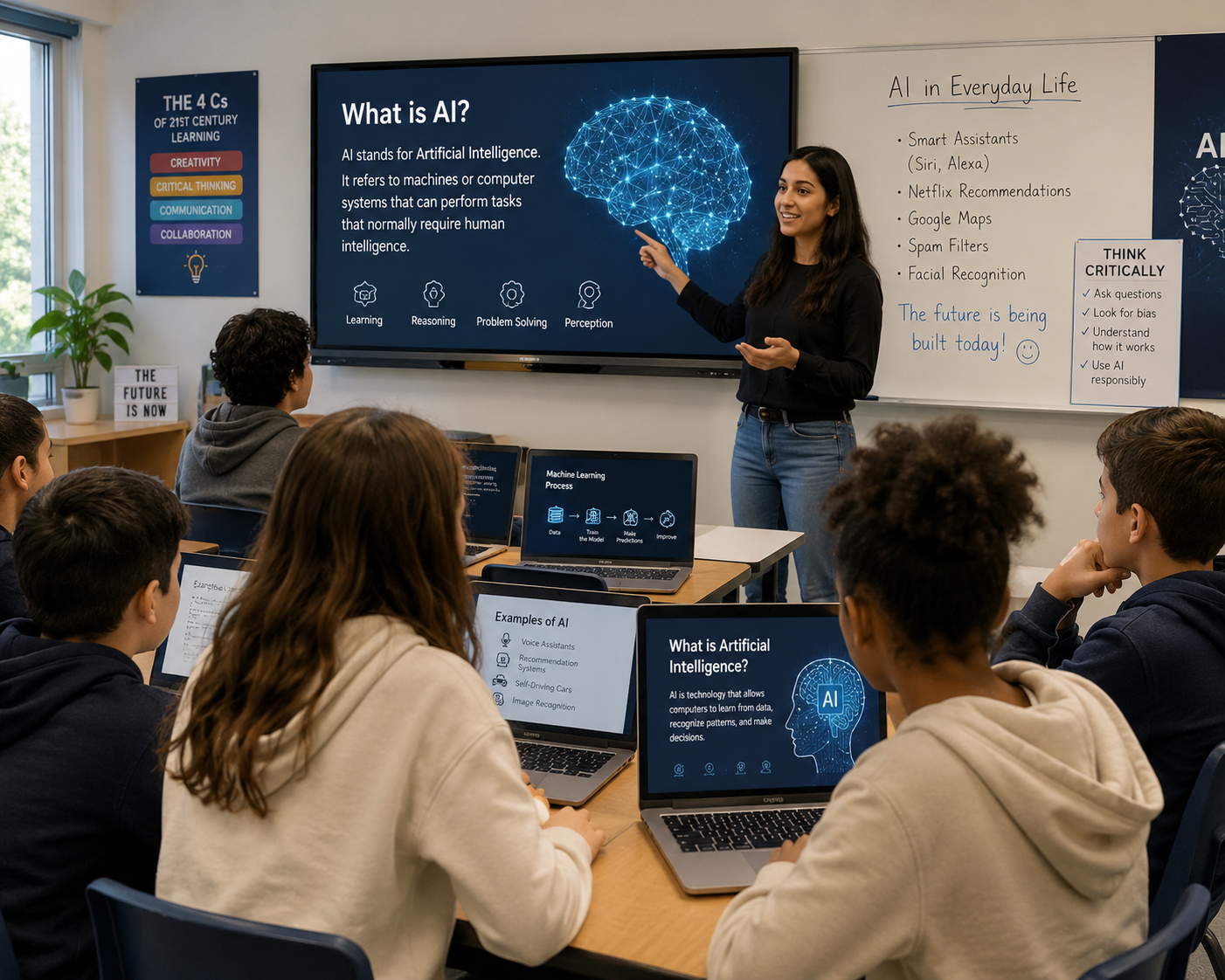
Students of all ages are becoming more dependent on AI for schoolwork and their daily lives. If this dependence is crucial for them to keep up with modern technology, should AI be taught in schools?
In the United States, about 86% of kids aged 9–17 use AI in their schoolwork, according to the Common Sense Media census. AI is already becoming a part of how students learn and complete assignments — but are students using it responsibly? As AI becomes a crucial skill in the workplace, teaching students when and how to use AI will avoid the spread of misinformation and the erosion of critical thinking skills. Students will continue to use AI — but will schools ever teach them how to use it?
Schools should consider mandatory courses in AI for students. With the rise of AI in the workplace, it is important for younger generations to grasp modern technology as early as they can. It only becomes a problem when students rely on it for mundane tasks and answer giveaways.
Here are some of the reasons why students should learn AI in the classroom.
01 / AI Accuracy
Teach students to fact-check the machine
One of the reasons we are hesitant about using AI is its accuracy. According to Duke University's Center for Teaching and Learning, a recent study found that AI chatbots incorrectly cite their sources 60% of the time. This means AI can provide false and misleading information — not to mention that AI has a reputation for giving biased responses.
Without any guidance, students who use AI will believe every response it gives them. That is how misinformation spreads. This is why schools should prioritize lessons on AI: students should be taught why and how to fact-check its responses to prevent spreading false information.
You can say that AI is a special tool for “summarizing” or gathering all findings into one space, but students must take caution and find out where that information came from. When checking the sources, students should ask themselves:
“Where in this article does it say that? Who wrote it? Did this information come from a Reddit user? A government website? A neuroscience researcher?”
If the provided sources are not helpful, students can try to verify the claim on a trusted source online or run it by an educator.
02 / When to Use AI
Not every problem deserves a chatbot
Students' lack of critical thinking skills may come from their heavy reliance on AI. Research shows that when AI is used irresponsibly, it hurts students' thinking skills. It does not allow the student to struggle and problem-solve; instead, they skip right to the solution without any reasoning.
For example, students should refrain from using AI for simple tasks. “What should I eat for dinner?” is a problem somebody can resolve on their own. Working it out themselves lets them think — Do I want leftovers? How many people will I feed? Do I want a protein-heavy dinner? — which activates their critical thinking.
In classrooms, students should learn the importance of using AI for more difficult tasks, such as reports and projects — and not for solving 23 + 56.
Before using AI, students should ask themselves whether the task can be solved on their own. This boosts their independence and problem-solving skills rather than relying on something else to decide for them.
03 / Thinking with AI
An assistant that challenges, not answers
When a student is asked to write an essay, asking AI to write it for them does not allow the student to practice their writing and reasoning skills. Instead, AI can aid students with their work — by challenging them.
For an argumentative essay, students can ask AI to find missing perspectives or weaknesses in their work. This can help students learn from their mistakes and receive valuable feedback.
Additionally, AI can ask the student important questions to consider, which requires the student to think and strengthen their essay. There are many more ways AI can be a helpful assistant in students' work without giving answers directly.
Teachers can lay out these rules for their students, making it clear how AI can be used and when to use it.
04 / Conclusion
A driver's license for AI
Since AI will be a bigger part of the workplace, schools should not look down on it. In most career paths, AI literacy will be a key skill — so teaching students how to use it responsibly and apply their own judgment is important.
Think of using AI like getting your driver's license. Before you are trusted on the road, you must first learn how to drive safely. In the same way, students must learn how to use AI responsibly before they come to depend on it.
The goal is to teach students how to use AI responsibly, and to encourage them to think and challenge themselves — instead of thinking less because of it.
Get AI scheduling insights, product news, and Bay Area community updates delivered to your inbox.
No spam. Unsubscribe anytime.