AI Doesn't Just Know What You Do. It Knows Why.
AI does not only learn from what we do — it learns from what we ask. Why conversations with AI reveal intention, not just behavior, what happens when that intent data meets commercial interests, and the boundaries society will need as our thoughts become data.

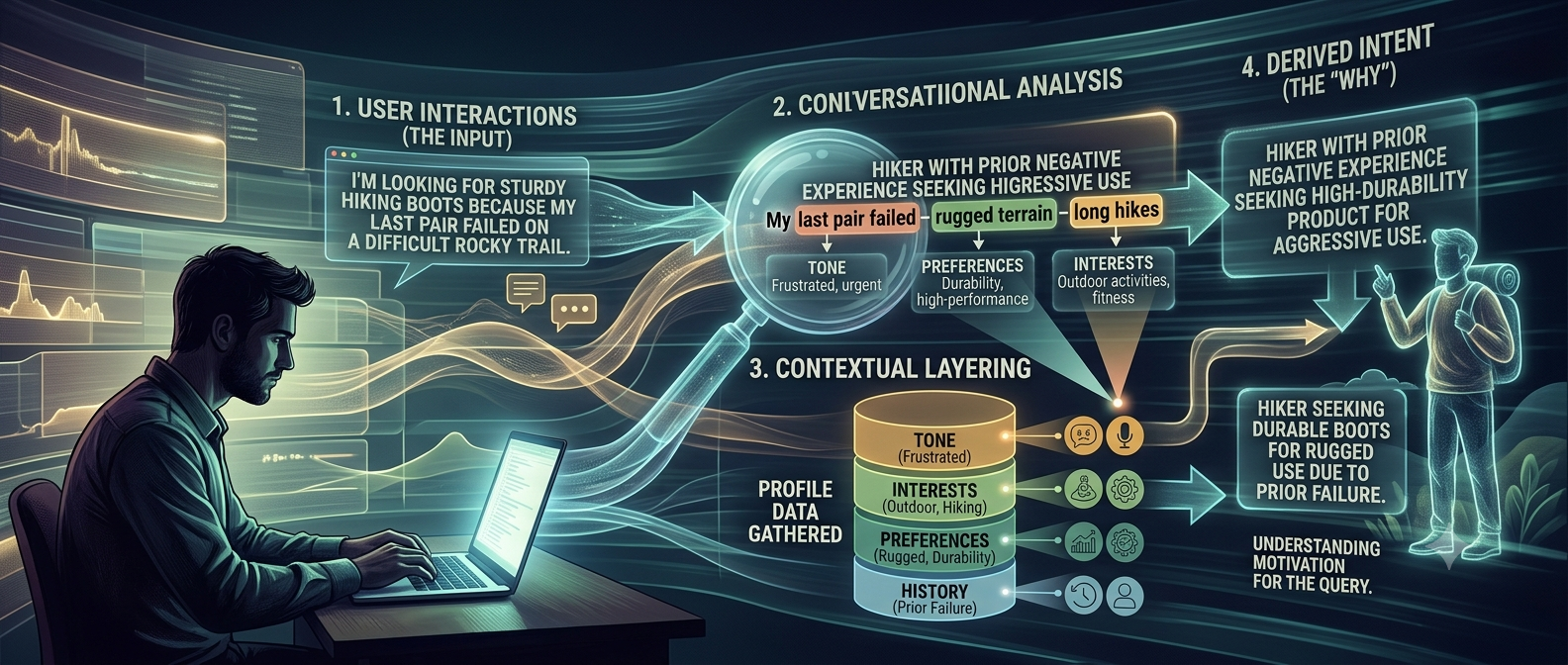
Every day, people use artificial intelligence in ways they may not realize reveal parts of who they are.
They ask AI to help write emails, solve problems, prepare for interviews, or recommend products. Some conversations are simple and practical. Others reveal personal struggles, goals, and uncertainties.
Unlike traditional technology, AI does not only learn from what we do. It also learns from what we ask. For the first time, we are creating technology that has access to our questions, our thought processes, and the problems we are trying to solve. This raises an important question:
What happens when our thoughts become data?
01 / Behavior vs. Intention
More than just information
When people think about data collection, they often think about basic information like names, locations, purchases, or search history.
But AI conversations are different. A search engine may know what someone is looking for. A social media platform may know what content someone enjoys. An AI conversation can reveal something deeper: why someone is looking for something in the first place.
There is a difference between knowing someone searched for a product and knowing they searched for it because they have a specific concern, preference, or problem they are trying to solve. One shows behavior. The other shows intention.
A search shows behavior. A conversation shows intention.
Over time, these conversations can reveal a person's interests, goals, habits, and ways of thinking in ways that traditional data collection often cannot.
02 / The Gap
The new privacy challenge
The challenge with AI is that people interact with it differently than they do with other technology.
People do not just enter keywords. They explain situations, provide context, and ask follow-up questions. A student may discuss career uncertainty. A developer may share an unfinished project idea. Someone may talk through a difficult personal decision. These conversations feel private because they feel similar to the kinds of conversations we usually have with people we trust.
But just because a conversation feels private does not mean it has the same protections. Unlike conversations with doctors, lawyers, or therapists, AI conversations generally do not have the same legal confidentiality protections. Instead, users depend on company policies, privacy settings, and security practices.
Just because a conversation feels private does not mean it has the same protections.
This creates a gap between how people experience AI and how their information is actually handled.
03 / The Incentives
When personal data becomes valuable
The internet has already shown how valuable personal data can be. Algorithms know what keeps us watching, what products catch our attention, and what content keeps us engaged. Companies have built entire industries around understanding human behavior.
But AI introduces something new: the ability to understand human intent.
I experienced something that made me think about this differently. I was using ChatGPT to ask for product recommendations and compare different options. I was looking for information and guidance, not trying to browse advertisements. During that experience, I noticed an advertisement appear within the chat. Seeing that made me think about the future of AI.
The concern was not simply that an advertisement appeared. Ads have existed online for years. The bigger question is: what happens when the same technology that understands our questions also becomes connected to commercial interests?
When AI helps us make decisions, we expect its responses to come from the information it has learned and the context we provide, not hidden business incentives. As AI becomes a more valuable source of consumer information, we need to consider whether these systems are helping us make decisions or influencing the decisions we make.
The ethical challenge is not only about what companies know. It is about how that knowledge is used.
04 / What Comes Next
The future of personal data
AI conversations create a new type of digital information. They are not just records of what we did. They are records of what we considered, questioned, and imagined.
As AI becomes a larger part of everyday life, society will need to decide what boundaries should exist around the information we share with it. Because the next generation of data collection may not only be about tracking our actions.
It may be about understanding our thoughts. Or worse, shaping them before we even realize it.
Get AI scheduling insights, product news, and Bay Area community updates delivered to your inbox.
No spam. Unsubscribe anytime.