All About AI Agents in Scheduling
Can AI accomplish a goal instead of just answering a question? A plain-language look at what makes an AI agent different from a chatbot — the think-act-observe-repeat loop, the receptionist analogy, and why agents are so useful for scheduling meetings.

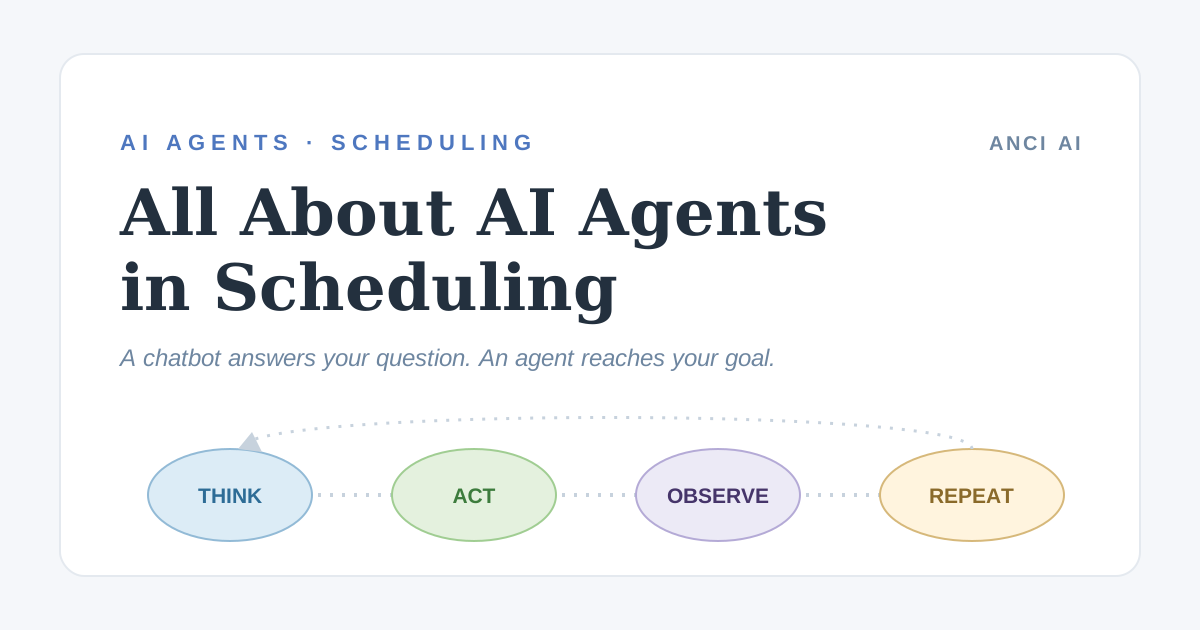
Can AI accomplish a goal if you ask it to, instead of answering a question? Is it able to create a plan to reach that goal? What if AI can do more than answer your question?
Start with something simple:
That is what a chatbot would give you. It answers your question, but it does not decide, plan, or use tools to reach a larger goal. You can think of an AI platform as “agent-like” when it does those things. So, what exactly is an AI agent?
According to Google, AI agents run through a multi-step process to achieve a specific goal, rather than just generating a single response.
Once we learn how an AI agent thinks, we can better understand what agents are and what they can be used for.
01 / How AI Agents Work
Think → Act → Observe → Repeat
AI agents break down a problem by following a (condensed) continuous process: think, act, observe, repeat. Each pass through the loop, the agent looks at what happened, adjusts, and takes the next step — until the goal is reached.
You can also think of AI agents as humans. They follow a similar set of steps to get tasks done. Let’s say you want to schedule a dentist appointment. Your receptionist would have to do the following:
This is how an AI agent tackles the problem to reach the goal — just how humans do.
This is made possible by a Large Language Model (LLM) that acts as a brain: it analyzes the goal, breaks it down into steps, and decides what the next steps are.
02 / Why They Are Useful
Scheduling without the back-and-forth
AI agents for scheduling can save plenty of time by scheduling meetings faster. They save us the hassle of having to ask every attendee for their availability. An agent can connect its different tools — Google Calendar, email, meeting platforms — to schedule meetings on its own. This prevents the annoying back-and-forth communication just to meet, and instead lands on a date and time that works for everybody.
AI agents can even adapt. They can look at everybody’s calendar, recognize a time conflict, and provide a list of options instead of making the user start over.
Unlike a chatbot that answers with a one-line reply, an AI agent can handle the work and take the necessary steps to reach the goal.
Get AI scheduling insights, product news, and Bay Area community updates delivered to your inbox.
No spam. Unsubscribe anytime.