Why AI-Assisted QA Is the Trend for AI Agents
An AI agent can pass every test in the suite and still get the outcome wrong. Why nondeterministic output, autonomous decisions, and context break traditional QA — and how AI-assisted evaluation, supervised by humans, is becoming a core part of testing AI agents.

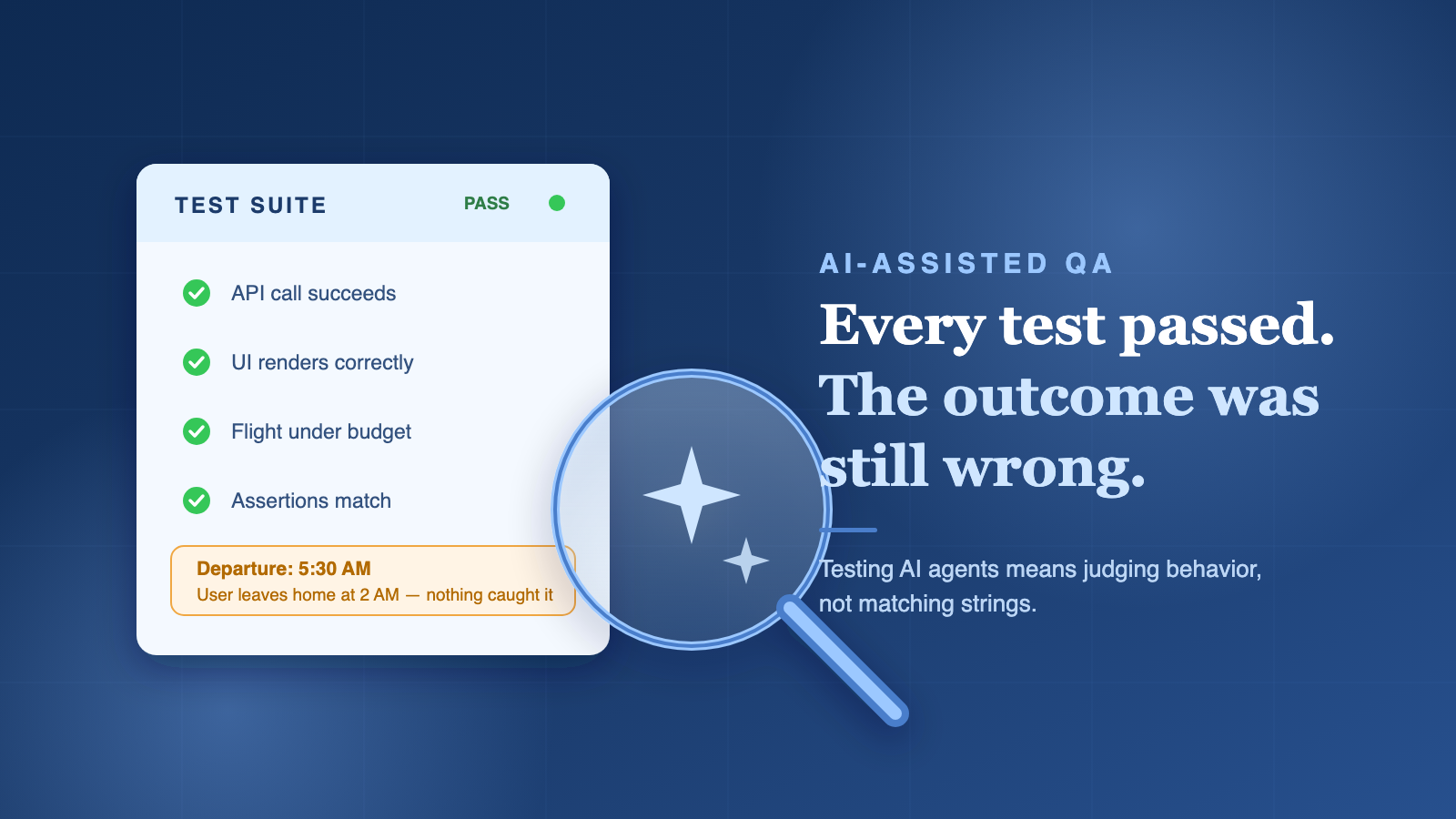
Nothing in the system is technically broken. It did exactly what the test asked it to do — and it still got the outcome wrong.
Imagine an AI travel planning agent successfully passing every test in your test suite. The API call succeeds, the UI works, the test case passes, and the flight comes in under budget. But the flight leaves at 5:30 AM, which means the user has to leave home at 2 AM. Nothing in the system is technically broken — it did exactly what the test asked it to do, and it still got the outcome wrong.
As AI agents become more autonomous and context-dependent, this kind of failure is becoming harder to catch with traditional QA alone. Testing AI agents requires more than checking whether a predefined expected output matches the actual output; it requires evaluating whether the agent's behavior actually makes sense for the user. AI-assisted QA is becoming a necessary direction for testing agents at scale: AI can help evaluate agent behavior, while humans remain responsible for defining what “good” means and supervising the evaluation.
01 / The Wrong Question
Traditional QA isn't enough for AI agents
Traditional software is relatively straightforward to test. We know what the input should be, we know what the output should be, so we write an assertion, run the test, and check whether the actual result matches what we expected. Traditional QA asks one question: did the system do what we told it to do?
For AI agents, that question stops being enough. An agent might complete every step in a workflow and still make a decision that is unhelpful, unreasonable, or inconsistent with the user's intent. AI-agent QA needs to ask something closer to: did the system do what the user actually meant? That difference matters most once we look at what actually makes AI agents different from traditional software.
Traditional QA asks: did the system do what we told it to do? Agent QA has to ask: did it do what the user actually meant?
02 / The Differences
What makes AI agents different from traditional software
Nondeterministic output. One of the simplest problems is also one of the most fundamental: AI does not always give the same answer twice. Imagine a user says, “I want a relaxing three-day trip to New York.” The agent might respond “Absolutely! Here's a relaxing itinerary…”, or “Sure, I've put together a laid-back three-day itinerary…”, or “No problem. Here's your three-day New York itinerary…” The wording is different every time, but all three responses could be perfectly acceptable. This breaks traditional automated testing, since we can't compare the agent's response against one expected string and call everything else a failure. What we actually need to know isn't whether the agent said exactly what we expected — it's whether the agent meant what we expected it to mean. That requires evaluating meaning, not exact output, which means something needs to understand the response itself.
Agents make decisions and take actions. AI agents are also different because they do more than generate text — they make decisions and take actions on behalf of the user. Consider a simple request: “Find me a flight from San Francisco to New York under $500.” One agent might choose a $420 flight with two stops and an 11-hour travel time. Another might choose a $480 nonstop flight that takes five hours. Both flights satisfy the explicit requirement, both are under $500, and both could pass a simple test — but which one is actually better? There may not be a single predefined answer. Testing an AI agent this way requires looking beyond whether the expected action occurred, toward whether the agent made a good decision.
Context changes what “correct” means. The third problem is context. Suppose the user simply says, “Book me the cheapest flight.” The cheapest flight might not be the best solution: if the user has a 9 AM meeting the next morning, a flight arriving at 8 AM may technically satisfy the request while creating an obvious problem, and if the user is traveling with checked luggage, an extremely cheap basic fare may no longer be the most reasonable option. The same action can be correct in one context and wrong in another, which is what makes AI-agent testing fundamentally different from testing a deterministic function — we often can't tell whether an action is correct without understanding the context in which the agent made it.
If we can't rely on exact outputs or predefined expected answers, we need another way to evaluate whether an agent's response and actions are reasonable in context. AI-assisted QA is one answer to that.
03 / The Shift
Why AI-assisted QA makes sense
AI is already good at working with natural language, and the same capability that lets an agent understand a user's request can also help evaluate another agent's response. Consider an agent that returns: “Your flight has been booked for $430.” A traditional test might check whether the response contains something like “flight booked.” An AI-assisted test can ask far more meaningful questions: Is the flight within the user's budget? Does it match the requested dates? Does it violate any stated preferences? Is the itinerary reasonable given the user's context? Did the agent accurately describe what it actually did?
Here, the evaluator isn't checking whether the response matches one predetermined sentence — it's evaluating whether the agent behaved appropriately. This is what makes AI particularly useful for testing AI agents: instead of manually reviewing thousands of possible responses, an AI evaluator can assess them at scale, flag potentially problematic behavior, and free up human attention for the cases that actually need review. That raises an obvious follow-up question, though: if AI is testing AI, who tests the tester?
04 / The Humans
Humans still have a role
An AI evaluator can also be wrong. It may misunderstand a business rule, miss an important piece of context, or confidently judge an inappropriate action as acceptable. Putting another AI model in front of the first one doesn't solve that on its own. Humans still need to define what “good” means, establish the criteria the AI tester evaluates against, validate ambiguous behavior, and review important or unexpected failures.
AI is better suited to handling scale, repetition, and large volumes of possible outputs; humans are still the ones responsible for the standards those outputs get judged against.
Get AI scheduling insights, product news, and Bay Area community updates delivered to your inbox.
No spam. Unsubscribe anytime.