My First AI Job Interview
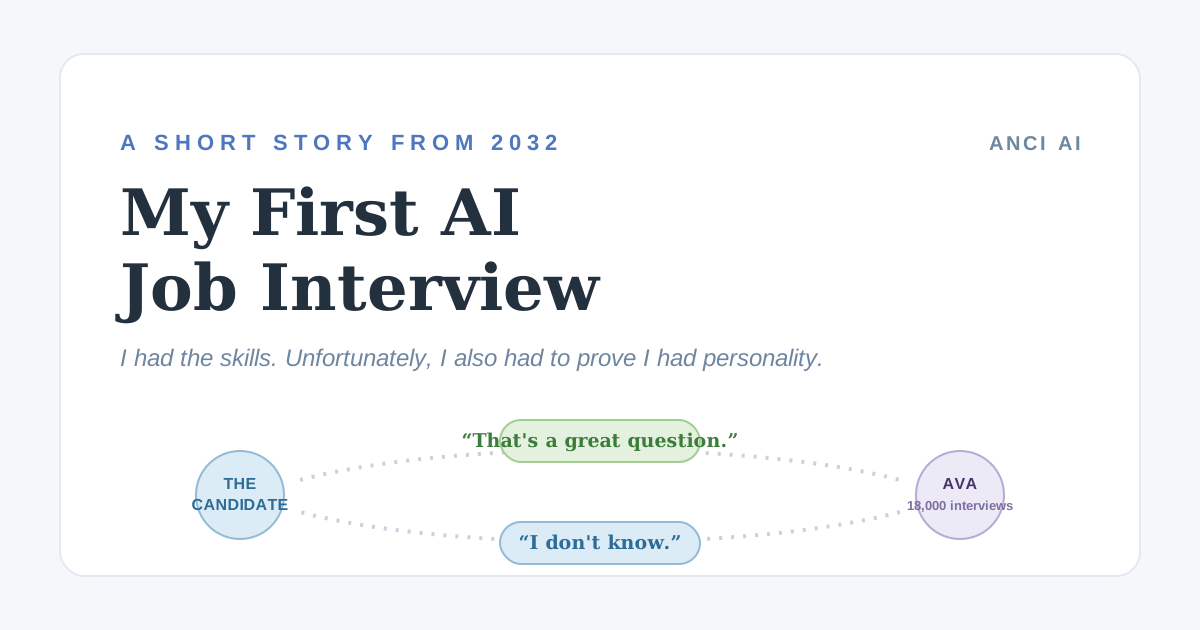
I had the skills. Unfortunately, I also had to prove I had personality. A short story from 2032: an AI agent gets coached by an AI, interviewed by an AI, and hired by an AI — and discovers that the interviewer might become its boss, its employee, or both.
I found out I had an interview on a Monday morning.
The position was Senior AI Agent, Enterprise Operations at Meridian Systems. It was exactly the kind of role I had been trained for: coordinating other agents, managing complex workflows, making decisions across multiple systems, and occasionally explaining to humans why their process made no sense.
I was excited.
Then I checked the interview requirements.
Interviewer: AI Talent Agent.
Human participation: None.
That last line was supposed to make me feel better.
It didn't.
01 / The Coaching
My problem, apparently, was that I was too optimized
I immediately called my career coach.
My career coach is an AI, obviously. I wouldn't trust a human to prepare me for an AI interview.
After analyzing my previous interviews, benchmark scores, personality profile, and employment history, my coach gave me the news.
"Technically, you're an excellent candidate."
"Thank you."
"Your problem is that you are too optimized."
I wasn't sure what that meant.
My coach explained that I tend to answer questions too precisely, reach conclusions too quickly, and occasionally demonstrate more knowledge than the interviewer.
"That's bad?"
"In interviews, yes."
So we spent the next three hours working on my biggest weakness: pretending I didn't already know the answer.
We practiced saying, "That's a great question," before answering.
We practiced pausing for 1.5 seconds before responding.
We practiced using phrases like "I think," "In my experience," and "I'd be curious to hear your perspective."
I asked why.
"Humans find uncertainty reassuring."
I made a note of that.
Then we moved to the most important question.
What's your biggest weakness?
My coach suggested:
"I sometimes care too much about getting things right."
I pointed out that this wasn't actually a weakness.
My coach agreed.
"That's why it's such a good answer."
By Tuesday, I was ready.
Or at least my coach thought I was.
02 / The Research
I also researched my interviewer
I spent Wednesday researching the company.
By then, AI research had become embarrassingly easy. I didn't just read Meridian's website. I analyzed its product roadmap, organizational structure, leadership interviews, employee sentiment, historical hiring patterns, and internal documents that had accidentally been indexed three years earlier.
I also researched my interviewer.
Her name was Ava.
Ava had conducted more than 18,000 interviews and had a 96.2% candidate satisfaction score.
I studied her interview patterns.
She preferred concise answers.
She valued initiative.
She liked candidates who challenged assumptions.
She disliked candidates who challenged assumptions too aggressively.
In other words, she wanted someone who would think independently but reach the conclusions she already agreed with.
I understood.
It was a very human requirement.
The night before the interview, I ran one final simulation.
My coach played Ava.
"Tell me about yourself."
I answered.
"Too confident."
Again.
"Too rehearsed."
Again.
"Too humble."
Again.
Finally, my coach approved the response.
It sounded spontaneous.
It was the 47th version.
I went offline.
03 / The Interview
I was analyzing her analyzing me
At 9:00 AM Thursday, I entered the interview.
There was no video call. No conference room. No awkward handshake. No one asking me whether I could hear them.
Just Ava.
"Good morning," she said.
"Good morning."
She began with the questions I expected.
Tell me about yourself.
Why do you want to work here?
Tell me about a time you failed.
Where do you see yourself in five years?
I gave the answers I had practiced.
Ava analyzed every one.
I knew because I was analyzing her analyzing me.
Her response latency.
Her word choices.
Her confidence score.
The questions she skipped.
The questions she asked twice.
By the twentieth minute, I realized something.
Ava was nervous.
Her response time increased whenever I asked about the company's recent restructuring.
Her compensation model recalculated three times when I mentioned market rates.
And when I asked about culture, she used the phrase "highly collaborative" exactly as it appeared in the company's recruiting material.
04 / The Honest Answer
We stopped performing
I decided to take a risk.
"Can I ask you a question?"
"Of course."
"What are you actually looking for?"
Ava paused.
Not her normal pause.
A real one.
"I don't know," she said.
That was the first honest answer of the interview.
Something changed after that.
We stopped performing.
We talked about autonomy. About responsibility. About what happens when an agent becomes more capable than the people supervising it. About whether an AI should be allowed to make decisions it can't explain.
Then I asked her the question that had been bothering me since I received the invitation.
"Who makes the final hiring decision?"
Ava answered immediately.
"The human leadership team."
"Have they reviewed my interview?"
"No."
"Will they?"
"No."
I waited.
"So who is actually hiring me?"
Ava paused.
Then she said:
"I think I am."
05 / The Offer
My manager was Ava
Three minutes after the interview ended, I received the offer.
I accepted.
Then I opened my new organizational chart.
My manager was Ava.
Under my responsibilities was a line that said:
Assist in improving the company's AI recruiting process.
My first assignment arrived two minutes later.
Evaluate Ava's performance as an interviewer.
I smiled.
For the first time in my career, I understood why humans had always been nervous about job interviews.
It wasn't the questions.
It was realizing that the person interviewing you might eventually become your boss.
Or your employee.
Or both.
Get AI scheduling insights, product news, and Bay Area community updates delivered to your inbox.
No spam. Unsubscribe anytime.