The Making of Luck in Tech
Luck looks like chance, but we play a bigger role in it than it seems. A look at blind luck versus controlled luck, personal agency, the 1% rule from Atomic Habits, and Richard Wiseman's newspaper experiment on why feeling lucky helps you notice opportunities.

Luck is superficially defined as achieving success or obtaining desirable outcomes purely by chance. Common examples include securing specific opportunities or experiencing unexpected growth — receiving funding, reaching one million views on social media, or meeting a key business partner. In a nutshell, these are often viewed as factors beyond one's control that lead to good outcomes affecting all aspects of life.
However, we play a bigger role in luck than it may seem. There are two types of luck: blind and controlled. Luck is a recurring theme in everything from growing a tech career to hitting personal milestones. Because “luck” is inherently subjective, everyone defines it differently based on individual experiences. But regardless of how it is interpreted, the real value lies in understanding the actionable steps that can be taken to maximize the surface area for these opportunities.
01 / Blind Luck
The factors beyond our control
First, it is important to acknowledge the factors that are almost impossible for one person to control, but that can have direct effects on them. Examples include health, winning a lottery that brings fortune, or meeting a mentor by chance.
These are real, and pretending otherwise is unhelpful. But they are also the smaller part of the story.
02 / Controlled Luck
The factors within our control
These are the factors we can use to maximize luck. Below are the mindset shifts needed for controlled luck.
Personal agency
This is the power to control one's own future. It involves intentionally defining your goals, breaking them down, and planning the steps to achieve them. It also means being open to new experiences, such as learning a new skill. Personal agency is when one views mistakes as learning points rather than a fixed end, and continues to maintain a growth mindset.
A unique path
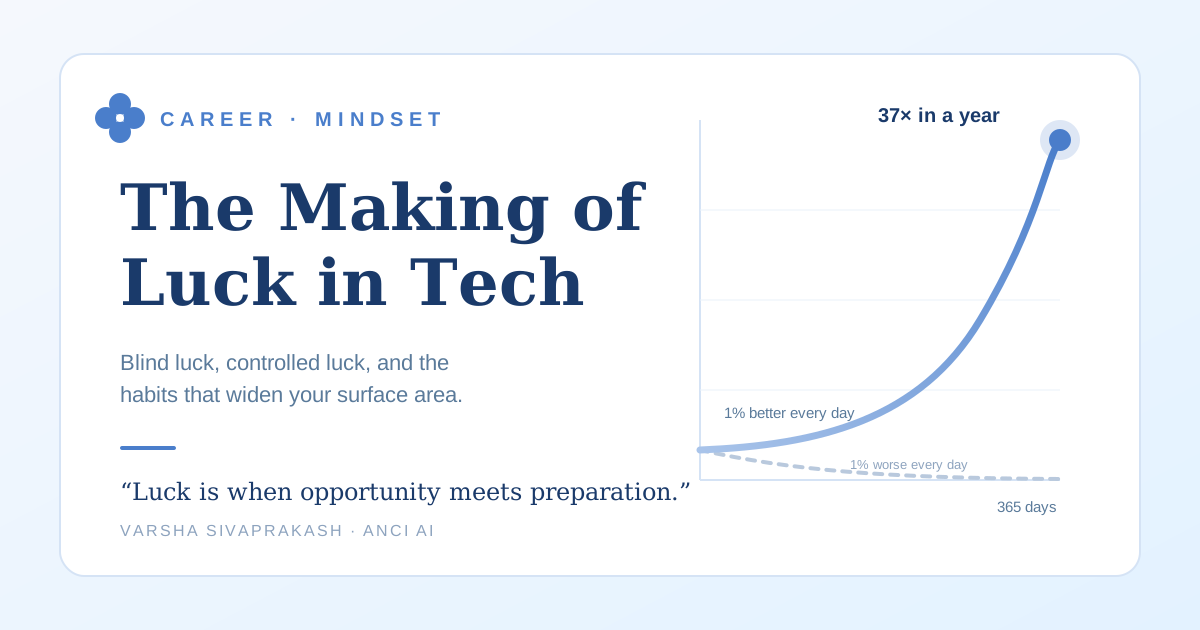
There is no single path to success. Rather, success is the accumulation of many small, consistent habits. Instead of focusing on finding the one right path, the better approach is to try improving a skill or working towards a goal 1% more than the previous day.
The 1% rule comes from Atomic Habits by James Clear, which states that getting 1% better each day leads to being roughly 37% better by the end of the year. An example could be reading a tech blog for 15 minutes every day and discovering what you want to learn more about.
1% worse every day → 0.99365 ≈ 0.03× — nearly zero
03 / The Newspaper Experiment
The power of feeling lucky
This experiment was documented in the book The Luck Factor by Dr. Richard Wiseman, a professor, psychologist, and author. A group of self-identified lucky and unlucky participants were both asked to count the number of photos in a newspaper.
The result: the “unlucky” participants took minutes, while the “lucky” participants took seconds for the same task. The lucky participants were quick to notice a page in the newspaper that explicitly stated the number of photos — because they were not fixated on just finding the pictures.
It is not enough to understand the actions needed to increase luck. You also have to feel lucky enough to notice opportunities when they arise.
04 / Conclusion
Luck is when opportunity meets preparation
Success is a journey rather than a destination. It is important to stay open to new experiences that are aligned with one's goals to maximize luck, while feeling lucky and consistently preparing for it.
By maintaining a growth mindset, one ensures that when the opportunity arises, technical preparation is positioned to make the most out of it.
Get AI scheduling insights, product news, and Bay Area community updates delivered to your inbox.
No spam. Unsubscribe anytime.