Your Head Start Has an Expiration Date
Notes from Yossi Feinberg's "AI and the Nature of the Firm" at the Stanford Ignite 20th reunion — the production function, the three chairs, migration cost as the size of your head start, and why every agentic system is secretly an org chart. Read through the eyes of an agentic AI founder.

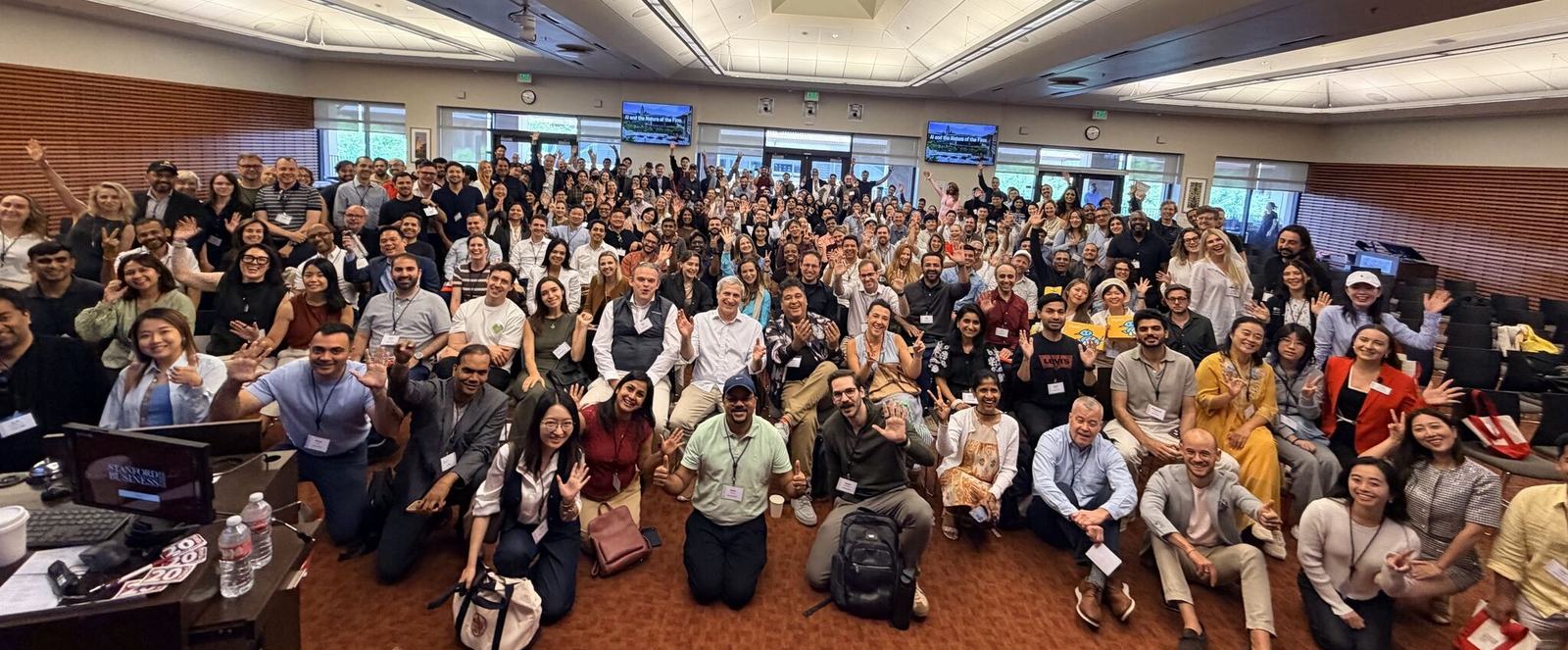
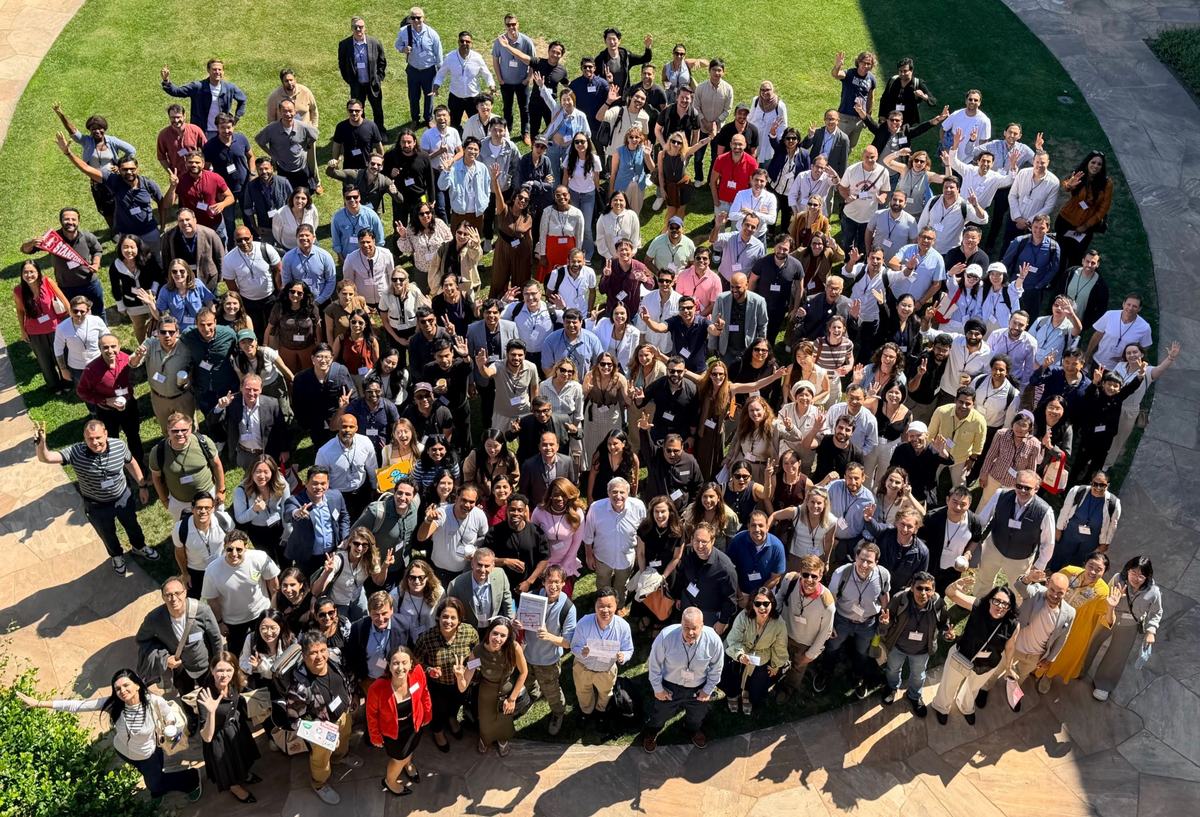
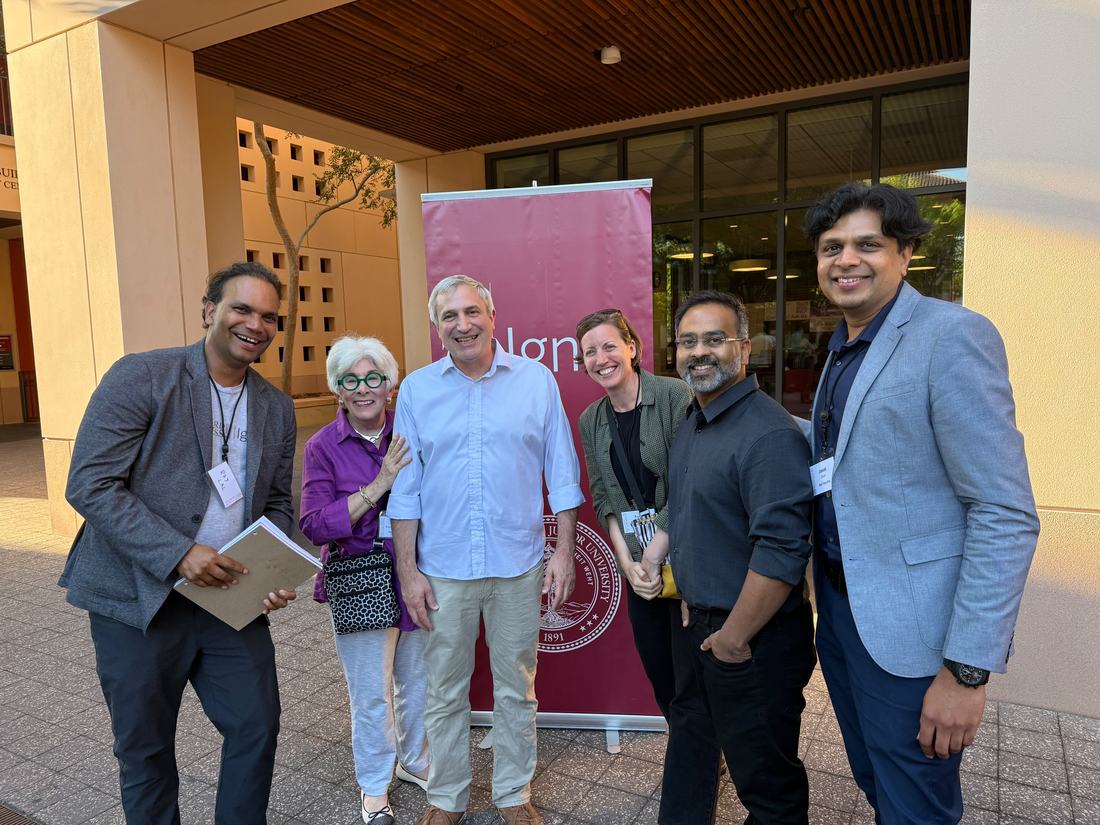
On August 5, 2026 I walked back into Stanford GSB for the Stanford Ignite reunion. Twenty years of the program. Thirteen years since my own cohort.
Same campus. Same faculty director. Yossi Feinberg was running Stanford Ignite when I sat in those seats in 2013, and he was on that stage again this month with a session called “AI and the Nature of the Firm.”
In 2013 I walked in with an idea and no company. This time I walked in with six years of engine behind me, an agentic platform coordinating across 90+ countries, and a considerably shorter list of things I am certain about.
I went in expecting a talk about AI adoption. I got a talk about my own business model.
Feinberg never mentioned scheduling, agents, or anything I build. He did not have to. He was working one level below all of that, on the question of what a firm even is once intelligence becomes something you can buy.
Here is what I took back to my desk.
01 / The Premise
AI is not another input
Every economics student learns the production function: capital in, labor in, output out. Feinberg's argument is that most companies today have quietly filed AI into that same equation as a cheaper substitute for labor, and that this is a category error.
Labor earned its own theory because humans respond to authority, meaning, incentives, and accountability in ways no machine ever has. AI is stranger still. It behaves like labor in some dimensions, like capital in others, and like nothing we have priced before in the rest.
He made it concrete with O*NET, the taxonomy that underlies most labor economics: “Every occupation requires a unique mix of knowledges, skills, abilities, activities, and tasks.” Then he walked an ordinary manager's day across that list. Getting information. Analyzing it. Thinking creatively. Interpreting meaning for others. Communicating up and down. Directing and motivating people. Controlling resources.
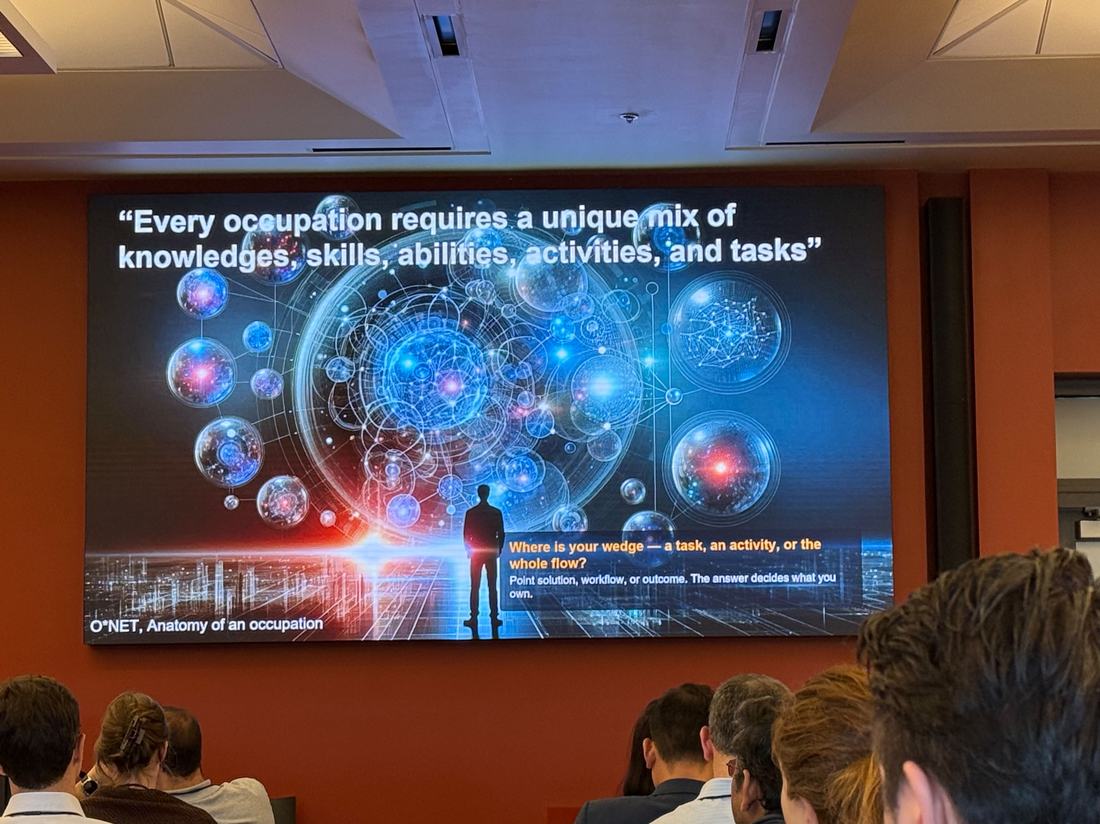
Then he asked which of those an AI cannot execute. On mechanics, almost none.
What survives is not operational. It is authority, accountability, and the question of who is answerable when it goes wrong. That is a much smaller and much more interesting remainder than most of us assume.
For founders he put the sharp version on the same slide: is your wedge a task, an activity, or the whole flow? Point solution, workflow, or outcome. The answer decides what you own.
02 / The Seating Chart
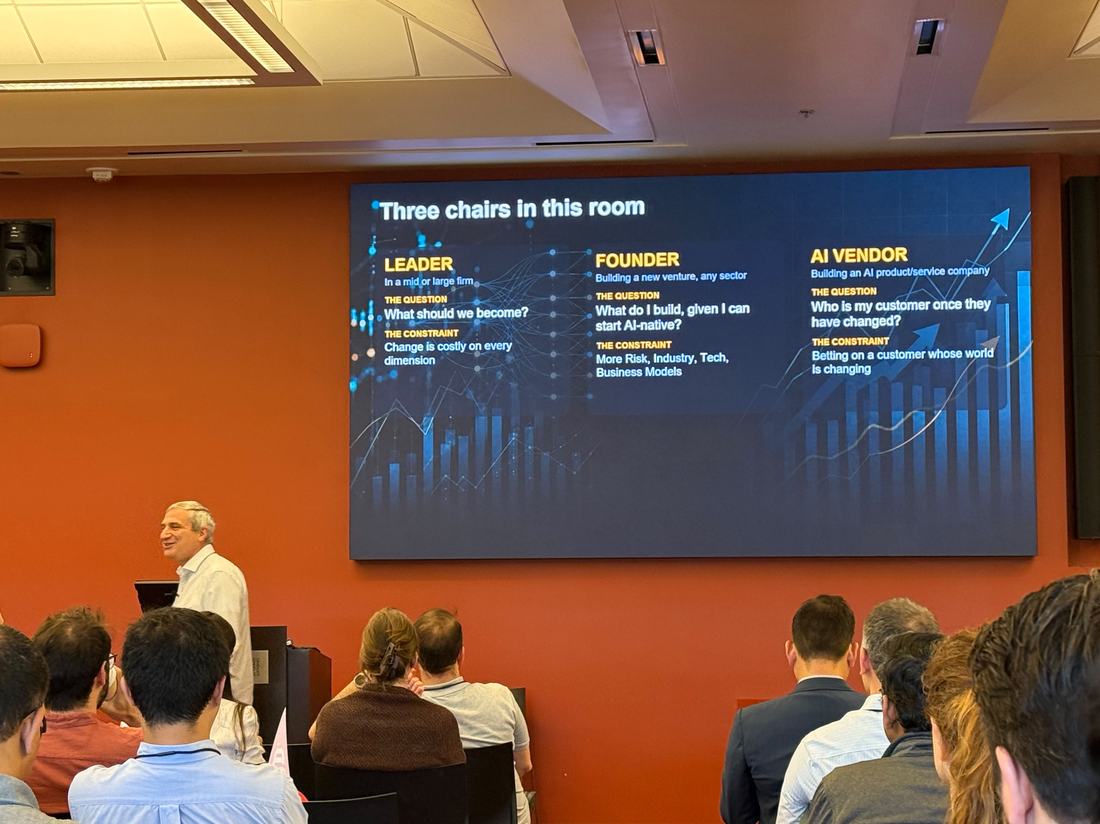
Three chairs in the room
Early on he split the audience into three, and the split held for the rest of the session.
The leader in a mid or large firm asks what we should become, and is constrained by change being costly on every dimension. The founder asks what to build given the option to start AI native, and carries risk on industry, technology, and business model at the same time. The AI vendor asks who the customer is once they have changed, and is betting on a customer whose world is moving underneath them.
I sit in the second and third chairs simultaneously, which I had never named as a specific problem before. Building AI native is one bet. Selling to companies that are mid transformation is a second, separate bet. They can both be right and still be pulling in different directions on any given quarter.
03 / The Asymmetry
What your head start actually is
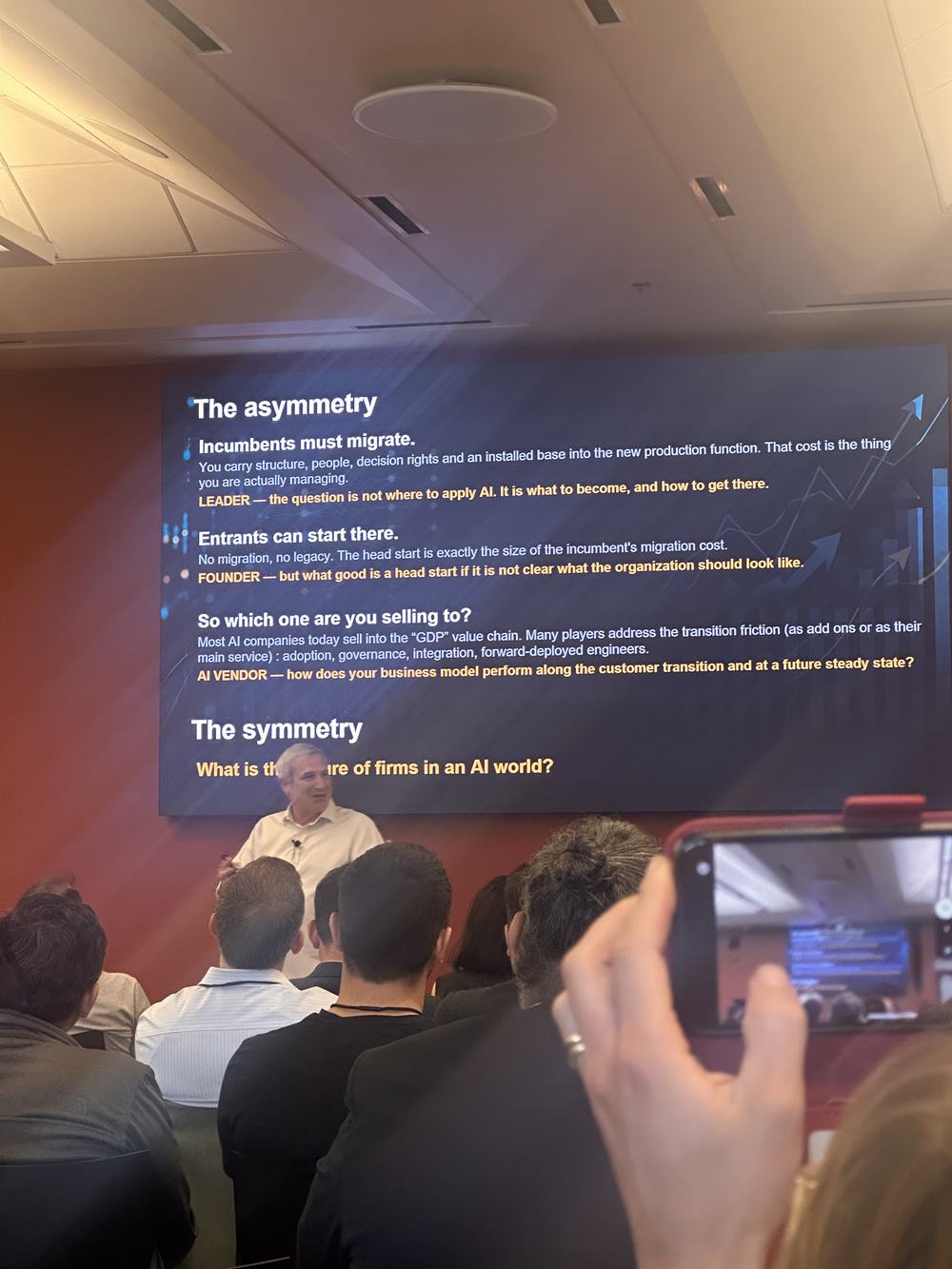
This was the slide that did the damage.
Incumbents must migrate. They carry structure, people, decision rights, and an installed base into the new production function, and that migration cost is the thing a leader is really managing. Entrants carry none of it.
“No migration, no legacy. The head start is exactly the size of the incumbent's migration cost.”
Read that again if you are building something. Your advantage is not your product, your model access, or your shipping speed. It is arithmetic performed on somebody else's balance sheet. And it depreciates every quarter they spend migrating.
He then turned it around on the room: what good is a head start if it is not clear what the organization should look like when you get there.
He also showed a chart contrasting the theoretical AI coverage of occupational categories against observed usage. The theoretical shape covered most of the map. The observed shape was a small red splinter near the center. That gap is the migration cost drawn as a picture. It is also, for most of us, the entire addressable market right now.
04 / The Inversion
Every agent system is an org chart
His organizational design sequence: strategy, structure, processes, people, intelligence, incentives, culture.
He pointed out that he had put people ahead of intelligence out of habit, and that the honest ordering runs the other way. Organizations started with humans and then asked where to insert AI. The real question is the reverse: given both human and artificial intelligence, what is the optimal way to organize all of it, and what is the human uniquely contributing.
Then came the line that made the room quiet. An agentic system is an organization. One agent executes, one verifies, one supervises, one routes. Almost every AI tool in the room already contained a small firm with reporting lines.
We are all doing organizational design. We just call it architecture and skip the part where we ask what it means.
What this changed for me
At ANCI we built a commit point: the moment an agent pauses before an irreversible action and hands the decision to a human. We designed it as a safety mechanism. Feinberg's framing says it is something else entirely. It is a decision-rights boundary. Where the human sits in an agent workflow is the same question as who signs off in a company. That is not a feature. That is a constitution.
05 / The Boundary
Coase, with a new input
He anchored the whole session in Coase: why do firms exist at all, instead of everything being contracted through markets. The classic answers are transaction costs, contracting frictions, and information problems, and nearly all of them are rooted in human behavior.
Now add intelligence to that mix. Feinberg's claim: intelligence shifts which activities can be traded at all, eliminating some sources of advantage inside an industry and creating others. The boundary of the firm moves.
For anyone building cross-organization anything, that is the thesis in one sentence. The scarce thing stops being work inside a company and becomes the trusted, neutral connective tissue between companies.
We have spent six years building exactly that: an engine that coordinates across 128+ organizations in 90+ countries, owned by none of them. I used to describe neutrality as a differentiator. After this session I would describe it as a position on a moving boundary, which is a very different thing to defend and a very different thing to price.
Someone asked whether companies will hire AI workers in five years. His answer was the economist's version of tough love: do not guess, analyze. Model the steady state of your industry, then ask whether it makes sense for a firm to own that labor or buy it from a market. Same test Coase handed us in 1937, new input.
06 / The Test
Two horizons, two different companies
The slide I have not stopped thinking about: most AI companies today sell into the transition. Adoption, governance, integration, forward deployed engineers. All of it is friction revenue.
His question to vendors: how does your business model perform along the customer transition, and at a future steady state?
My answer, written down plainly: agent to agent coordination has strong steady state logic, because more agents means more coordination, not less. It has weak transition revenue, because buyers still file scheduling under calendar features. I have been pricing for the steady state while selling into the transition. That is a real gap, and naming it is the beginning of closing it.
07 / The Stack
Know one layer down
His rule: whatever layer you build on, understand the economics of at least the layer beneath you, because that layer's cost curve sets the ceiling on your plan. Memory bandwidth and inference pricing are not somebody else's problem when your margin is denominated in tokens.
The mega trend he flagged runs upward. The application layer is now pulling development in the foundation models, the middleware, and the frameworks below it, rather than waiting to receive it.
08 / The Work
What I am changing on Monday
His practical advice to leaders was blunt: start moving, and start with the low hanging fruit. Waiting for clarity is itself a decision, and usually the expensive one, because direction is far easier to correct once you are already in motion. He described NVIDIA discovering that its own engineers barely used AI, and responding by requiring every team manager to report how their team had increased usage. Culture, he argued, matters enormously during implementation and probably matters less at the steady state than business schools like to claim.
- Write the five year organization before the next roadmap. I have been running product roadmaps where I should have been running org designs.
- Re-underwrite the model on both horizons. Transition pricing and steady state pricing are different exercises. I had been doing one and reporting it as both.
- Treat every commit point as a decision-rights choice. Not a safety toggle. A statement about who is accountable.
Thirteen Years Later
In 2013 the curriculum taught us how to build a company. Customers, business model, unit economics, the pitch at the end. Every one of those still holds. But the reunion session asked a question the 2013 syllabus had no reason to ask, which is whether the company is still the right unit at all.
That is the distance between 2013 and 2026, and it is longer than any product cycle in between.
The Takeaway
The head start is real. It is also a depreciating asset — exactly the size of the incumbent's migration cost, shrinking on their schedule, not yours.
Spend it on the organization that should exist.
ANCI AI Research & Insights · 2026
Get AI scheduling insights, product news, and Bay Area community updates delivered to your inbox.
No spam. Unsubscribe anytime.