
The AI Mirage · Framework · July 2026
Risk-Tiering Your Use Cases
One AI policy for everything is the surest way to be both reckless and slow. The fix is a tier — a simple map from "brainstorm freely" to "zero error" that tells you exactly how much to worry.
Most organizations approach AI risk with a single dial set to one of two extremes. Either they treat every AI use as dangerous — routing each idea through legal, demanding sign-offs, slowing everything to a crawl — or they treat every use as harmless, letting AI touch customers, contracts, and money with the same casual freedom as an internal brainstorm. Both are the same error: applying one level of caution to wildly different situations. The AI that drafts a birthday message and the AI that approves a loan are not the same risk, and no single policy can be right for both. The discipline that fixes this is risk-tiering, and it is the quiet backbone under every other practice in this issue.
01 — The One-Size MistakeRisk lives in the use case, not the model
The foundational insight is deceptively simple: the same AI model carries completely different risk depending on what you point it at. Risk is not a property of the technology; it's a property of the job. GPT-class models don't come with a risk rating, because the model that writes a throwaway internal summary and the model that answers a patient's medication question can be literally the same model. What changed is not the intelligence — it's the consequence of being wrong. Any governance approach that assesses "our AI" as a single thing is measuring the wrong object. You don't tier the model; you tier the use.
This is why blanket policies fail in both directions. A blanket ban — "no AI near anything important" — surrenders the enormous, safe value of low-stakes automation and pushes employees toward using unsanctioned tools in the shadows, which is worse. A blanket green light — "AI everywhere, move fast" — is how a company ends up with a hallucinating chatbot bound by a tribunal or a policy invented on the fly. The organizations that get real value from AI without getting burned do neither. They accept that their AI portfolio contains a spectrum of risks and they govern each use at the level it actually warrants — which requires, first, a way to tell the levels apart.
Regulators reached this conclusion before most companies did, which is a useful signal. The EU AI Act is built entirely on tiers — it sorts systems into unacceptable, high, limited, and minimal risk, and attaches obligations that scale accordingly. The NIST AI Risk Management Framework takes the same risk-proportionate posture. The convergence is not a coincidence: anyone who has thought seriously about governing AI at scale arrives at the same structural answer, because it's the only one that doesn't collapse under its own weight. A rulebook that treats every use identically is either too strict to permit the easy wins or too loose to prevent the disasters. Tiering is what lets a single framework be simultaneously permissive where it can be and strict where it must be.
02 — The Two AxesWhat actually sets the tier
Two questions locate almost any use case on the risk map. The first: how bad is it if the answer is wrong? A wrong brainstorm is a shrug; a wrong dosage or a wrong wire transfer is a catastrophe. The second: how exposed and autonomous is the output? An answer a colleague sanity-checks before anything happens is far safer than one that goes straight to a customer or triggers an action with no human in between. Consequence and exposure, together, do the sorting.
Reading the map, the pattern is intuitive. Down in the low-left corner — trivial consequences, internal and supervised — sits the vast, safe majority of AI usage. As you move up (worse failures) and right (more exposure, more autonomy), the tier climbs, until the top-right corner holds the uses where a confident hallucination could be ruinous and irreversible. A few sharpening questions refine the placement: Is the output regulated? Could an error cause physical, financial, or legal harm? Does the system act on its own, or does a human gate it? Can a mistake be undone? Each "yes" toward harm, autonomy, and irreversibility nudges the use case up a tier. The point isn't precision to three decimals; it's landing every use in roughly the right band so its controls can be set accordingly.
03 — The Four TiersWhat each level demands
Here is where tiering stops being a diagram and starts saving you from headlines. Each tier prescribes how much of this issue's machinery — grounding, evaluation, human oversight, accountability, disclosure — a use case actually needs. The controls scale with the tier: cheap and light at the bottom, exhaustive at the top.
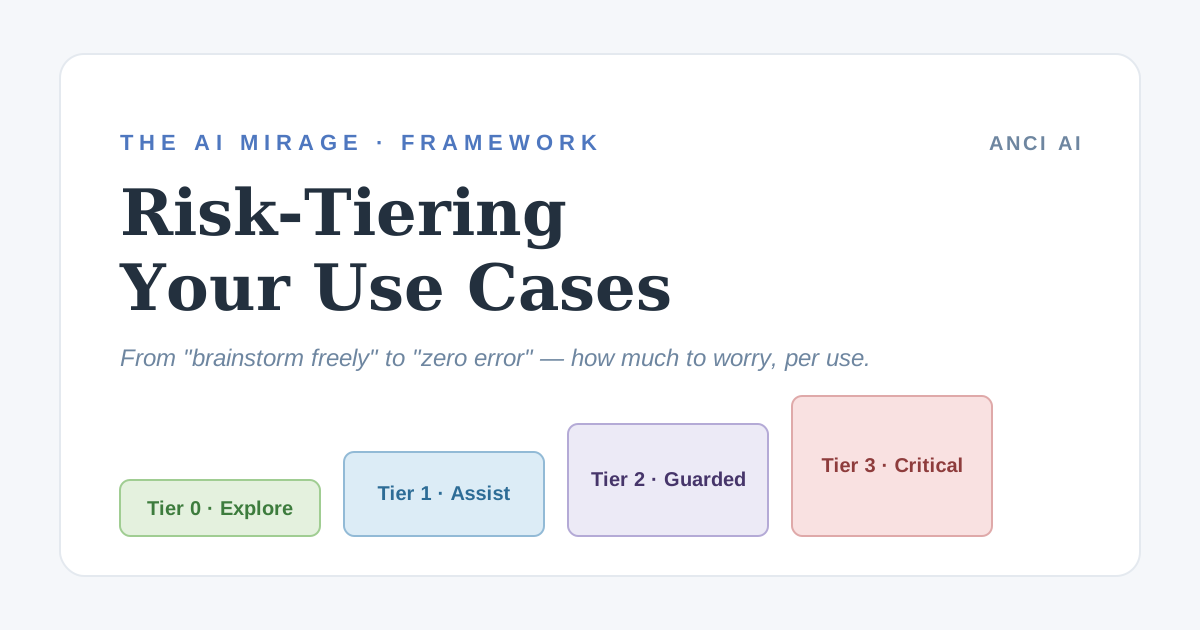
Tier 0 · Explore covers internal, low-stakes, human-checked uses — brainstorming, first drafts, summarizing your own notes. Here the right amount of governance is nearly none: let people move fast, log usage, and stay out of the way. Tier 1 · Assist is AI that drafts something a human will finish and own — a proposal, an email, an analysis. The human is the safety net, so light grounding and a basic eval suffice. Tier 2 · Guarded is the moment AI speaks to the outside world — customer chatbots, public content, anything where an error reaches someone you don't control. Now grounding is mandatory, evals run continuously, a named owner exists, and users are told they're dealing with AI. Tier 3 · Critical is the regulated, irreversible, high-harm territory — money, health, legal, safety. Everything is turned up to maximum: audited grounding, red-teamed evals, a human signing off on every action, board-level visibility, and full disclosure. The genius of the scheme is that most of your uses live in Tiers 0 and 1, where governance is cheap — so you can afford to be exhaustive in the rare Tier 3 cases that could actually end you.
Two cautions keep the scheme honest. The first is tier creep: a use case that launched as a harmless Tier 1 internal draft has a way of quietly graduating — someone wires its output directly to customers, or an "assistant" gains the ability to take actions on its own — without anyone re-running the classification. The tier must be reassessed whenever the use changes, not set once and forgotten, because the controls that were adequate for the old tier become dangerously thin for the new one. The second is gaming: because higher tiers mean more work, teams under deadline pressure have a standing incentive to argue their use case down a level. That's why classification can't be pure self-service — self-classification is fine for speed, but spot-audits and a clear escalation path for anything customer-facing are what stop the whole system from silently sliding toward "everything is Tier 0." The framework only protects you if the tier assignments are truthful.
04 — The AcceleratorTiering says yes faster than it says no
The counterintuitive payoff — and the reason to sell this framework internally as an enabler, not a brake — is that tiering makes an organization faster, not slower. When every AI idea is treated as potentially dangerous, everything queues behind the same heavyweight review, and the safe 80% of use cases die waiting for scrutiny they never needed. A tiering system flips that: it lets you say an instant yes to Tier 0 and Tier 1 — the bulk of ideas — precisely because you've reserved your caution for the tiers that warrant it. Governance stops being the department of no and becomes the mechanism that clears the runway.
To make it operational, keep the classification light enough that a product manager can do it in a meeting, not a process that requires a consultant. Three questions carry most cases: Does the output leave the building? Can it act autonomously or cause irreversible harm? Is it regulated? Those route a use case to its tier in under a minute, and only genuine Tier 2 and Tier 3 cases escalate to deeper review. Publish the tiers, publish the controls each requires, and let teams self-classify with spot-audits to keep them honest. The result is a portfolio you can actually see — you know how many Tier 3 systems you run and who owns each — and an innovation pace that isn't strangled by treating a birthday-message generator like a loan engine.
There's a strategic bonus that leaders tend to discover only after the fact. A tiered portfolio gives you something almost no company has in the current AI scramble: a clear, honest inventory of where you're actually exposed. When a board member, an auditor, or a regulator asks "what AI are you running, and how do you know it's safe?", the untiered organization can only shrug and gesture at a pile of pilots. The tiered one can answer instantly — here are our three Tier 3 systems and their named owners, here's how many Tier 2 customer touchpoints we run, and here's the control each one meets. That legibility is itself a competitive and governance asset. In a world where AI incidents are becoming a boardroom and reputational risk, being able to prove you know exactly where your dangerous uses are — and that they're the ones getting the scrutiny — is worth as much as any individual control.
The reframe for skeptics
Risk-tiering isn't bureaucracy; it's the opposite. It exists so that 80% of your AI ideas can ship immediately without a committee — because you've drawn a clear, defensible line around the 20% that genuinely need one.
The TakeawayMatch the caution to the consequence
The costliest AI governance mistake is uniformity — one level of worry applied to a portfolio of wildly different risks, which guarantees you'll be both reckless and slow. Risk lives in the use case, not the model, and two questions place any use on the map: how bad is a wrong answer, and how exposed and autonomous is it? Sort your uses into tiers, and let the tier prescribe how much grounding, evaluation, oversight, and accountability to invest — light at the bottom, exhaustive at the top. Done well, tiering is an accelerator: it says yes to the harmless majority instantly and reserves your scrutiny for the few decisions that could actually end you.
From ANCI AI
Agents governed at the level the stakes demand
ANCI builds AI agents with tiered controls baked in — light-touch where the stakes are low, and grounding, verification, and human sign-off dialed up exactly where a wrong answer would actually hurt. One framework, calibrated per use case, not one policy for everything.
Explore ANCI
Sources: Risk-based AI governance frameworks, including the tiered-risk approach of the EU AI Act and the NIST AI Risk Management Framework; synthesis with grounding, evaluation, human-oversight, and accountability practices covered elsewhere in this issue.
Article 7 of 10 · The AI Mirage · AI Edge for Leaders.