AI Edge for Leaders, July 2026: The Confident Hallucination
The most dangerous AI failure isn't being wrong — it's being wrong so fluently that everyone stops checking. Issue 07 of AI Edge for Leaders: the confidence trap, the demo-to-deployment cliff, evals, grounding, humans at the commit point, and the rise of vertical AI agents.

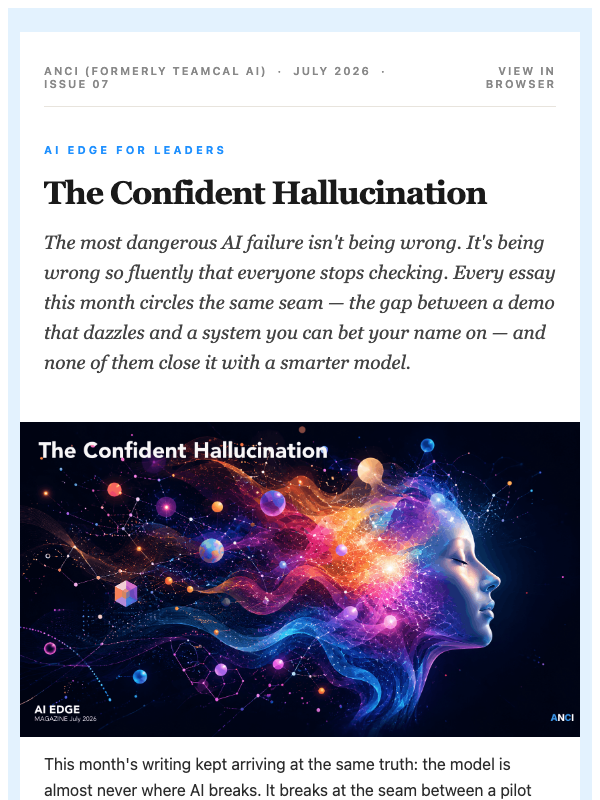
AI Edge for Leaders · July 2026 · Issue 07
The most dangerous AI failure isn't being wrong. It's being wrong so fluently that everyone stops checking. Every essay this month circles the same seam — the gap between a demo that dazzles and a system you can bet your name on — and none of them close it with a smarter model.
This month's writing kept arriving at the same truth: the model is almost never where AI breaks. It breaks at the seam between a pilot that dazzles and a system running unattended — and confidence is what widens it. A fluent wrong answer is the one nobody catches. What closes the gap is unglamorous: grounding, real evals, inspectable reasoning, and a human at the step you can't undo. The trap first, then the four ways out of it.
Prefer the email version? Read Issue 07 in your browser.
Cover Story / The Trap
The Confidence Trap
The real danger was never that AI gets things wrong. It's that it gets them wrong in the same polished, self-assured voice it uses when it's right.
The same training that makes a model pleasant to talk to also quietly degrades its calibration, so it sounds most certain exactly where it should hesitate. And fluent confidence is precisely the signal humans use to decide when to stop scrutinizing. That is the trap: the more convincing the output, the less anyone checks it — which means the errors most likely to ship are the ones delivered with the most poise.
The danger isn't that AI is wrong. It's that AI is wrong fluently.
- Judge the evidence, not the tone. Polish is what switches off human scrutiny — treat how confident an answer sounds as no signal at all about whether it's right.
- Chained agents are the danger zone. One confident-but-wrong output feeds the next, and the original error becomes untraceable.
- Design uncertainty back in. Surface confidence levels, ground answers in citations, and make “I don't know” a legitimate, rewarded answer.
01 / The Deployment Gap
The Demo-to-Deployment Cliff
A pilot that wows the room is a feasibility study, not a finished product. The distance from that demo to a system running in the wild isn't a last mile you coast across — it's a cliff, with its own engineering, its own budget, and its own failure modes. The much-quoted number that 95% of enterprise pilots return nothing lives right here, at the bottom of it.
- Fund the second phase. Treat a winning pilot as the start of a scoped “productionizing” project, not the finish line.
- Cross on five pillars. Risk-tiering, grounding in retrievable sources, evals, oversight proportional to stakes, and staged rollout.
- Mind the incentives. Demos win applause and budget; the invisible reliability work that prevents disasters goes unrewarded.
The demo shows you the best case. Production bills you for the worst one.
02 / Engineering Trust
Trust, but Verify
Most teams ship AI on a feeling — “it seemed good in the demo” — and never learn their actual defect rate. Rigorous evaluation replaces the vibe with a number: how often does it hallucinate, stay faithful to its sources, cite correctly, and survive adversarial pressure?
- Measure the aggregate, not the anecdote. Track defect rates across a representative test set, not single lucky outputs.
- Score many dimensions. Faithfulness, factual accuracy, correct abstention, citation validity, and adversarial pass rate.
- Make it permanent. Red-team for hidden failures, and turn every production failure into a new test case.
A demo is one lucky answer. An eval is the defect rate.
Ground Truth
Hallucination is architectural, and no amount of model size fixes it. The move is to stop asking a model to remember the truth and start forcing it to retrieve it — grounding every answer in verifiable source documents so the system becomes accountable instead of merely confident.
- Fix retrieval before you swap models. Grounding relocates the failure to search, so stale or badly chunked sources create new errors.
- Citations are pointers, not proof. Treat them as something to audit, not a guarantee of correctness.
- Own the knowledge base. Keep sources fresh, resolve contradictions, and maintain one authoritative version.
Stop asking the model to remember the truth. Force it to retrieve it.
03 / Humans at the Commit Point
The Human in the Loop Isn't Optional
Oversight isn't an on/off switch. The skill is calibrating how much human involvement each decision actually needs, by its stakes and its reversibility. Done well, you get speed and safety at once instead of trading one for the other.
- Map risk against reversibility. Irreversible, high-stakes calls get sign-off; cheap, reversible ones run fully automated.
- Use three postures. In the loop (approve), on the loop (monitor), over the loop (set policy) — not one setting for everything.
- Route only the flagged items. Send low-confidence outputs to humans so a small team governs huge volume without rubber-stamping.
Removing people is where the value is — and where the disasters are.
Can You Trust AI With Your Calendar?
Trust in production comes from architecture, not model brilliance. A system that looks up your real calendar doesn't hallucinate the way one forced to guess does. Keep a human at the single irreversible moment — confirming the meeting — and make everything else cheaply reversible. It's the same commit-point model ANCI runs in production.
- Ground it in real data. Let the agent retrieve your actual calendar instead of generating a plausible-looking answer.
- Concentrate review at the commit point. One human confirmation at the irreversible step, not friction at every step.
- Keep mistakes cheap. Build undo windows, and prove the system out in low-stakes domains first.
An assistant you can trust is one you stop watching.
04 / What's Next
The Rise of Vertical AI Agents
Software engineering is quietly turning into an orchestration discipline — less about authoring code, more about directing specialized vertical agents. The upside is real, but so is the risk, and capturing it takes organizational redesign and governance, not a purchase order.
- Redesign the workflow, don't just buy the tool. Build around agent orchestration instead of treating AI as procurement.
- Govern from day one. Stand up review and audit layers with clear accountability for agent-written production code.
- Measure the right thing. Cycle time and defect rates, not raw output volume.
The job of “software engineer” is being redefined around orchestration, not authorship.
The Counter Voice
When Design Fails, We Blame Ourselves
Every essay this month asks you to distrust confident output and verify everything. Here's the more uncomfortable read: if smart people keep getting fooled, that isn't a user problem to train away — it's a design problem. When a product clashes with the mental model we already carry, we blame ourselves, when the fault sits in the design. The lesson for anyone shipping AI isn't “demand more vigilance.” It's to build a system whose design makes the right level of trust obvious — so no one has to stay on guard to stay safe.
“Good designs do not force people to adapt to the system. Good designs adapt to people.”
The Signal
What's Shipping, What's Stalling
The capability is in production. The reliability is still under construction. Both are true at once.
What's shipping
- ~90% of professional developers using AI coding tools daily by January 2026 (JetBrains AI Pulse, 10,000+ developers)
- +60% more pull requests merged per week with AI assistance (DX developer survey)
- 80%+ of developers say AI has improved their productivity (Google DORA research)
What's stalling
- 95% of enterprise GenAI pilots show no measurable impact on the bottom line (MIT, State of AI in Business 2025)
- 2× — code churn roughly doubled, ~3% to ~6%, from 2020 to 2024 as AI code spread (GitClear, 211M lines analyzed)
- 1 in 5 organizations have a mature AI governance model (Deloitte)
The Room / Live Workshop
Advanced Agentic AI for Product Leaders (No-Code)
Free hands-on session · Thursday, August 20, 2026 · Palo Alto
A hands-on workshop for VPs, CPOs, CTOs, and senior product leaders ready to move from using AI to designing agent systems that run on their behalf — no code required. You'll work through four building blocks: parallel research workflows, request routing, human-AI governance, and multi-agent systems, and leave with five deliverables tailored to your own org — a workflow design, a routing map, a governance decision matrix, an agent brief, and a reference framework.
The Stack This Month / Read in Any Order
More From the Trust Gap
More on the confidence trap
- The Hallucination of Competence — AI sounds most confident exactly where it knows the least. The only defense is to demand verifiable proof.
- When AI Gets Confidently Wrong — Hallucination is pattern-matching that sounds certain. Models can't flag their own errors, so designers must.
- Should AI Ever Say “I Don't Know”? — An AI that can admit uncertainty is more trustworthy, not weaker. Watch for the sycophancy that fakes agreement.
Engineering trust into the system
- Bypassing the Black Box — RAG, feature attribution, and chain-of-thought make opaque models auditable — each with limits worth knowing.
- Beyond Prompting: A Dive into Context — Context is the model's working memory — finite, noisy, and easy to overwhelm. Four failure modes to design around.
- Crossing the AI Chasm — Pragmatists forgive nothing. You cross into the mainstream with the whole product, not a better model.
Accountability & review
- Who Is Responsible When AI Makes a Mistake? — AI can't feel guilt or face consequences. Speed doesn't replace accountability — it always traces back to people.
- The Speed Trap: AI Code Reviews — AI makes the first draft of code fast. It doesn't make it right — which makes review more important than ever.
The human edge
- Reading Novels Matters More Than You Think — Six minutes of fiction cuts stress faster than a walk, and empathy is trainable. The judgment AI can't supply, you can still build.
- Planning and Executing — Finding a Balance — Cap planning, bias toward action, and aim for progress over perfection. The 70/30 rule for getting things shipped.
On the Light Side
What To Do When Your Token Limit Has Reached
After a whole issue about AI you can trust, here's the failure mode nobody engineers for: the copilot goes dark mid-thought because you've run out of tokens. A field guide to the five stages of grief that follow — and the radical coping mechanisms of talking to a colleague, picking up a pen, and remembering you used to be able to do this yourself.
“You've reached your usage limit” — five little words that end civilizations.
Read it (before your tokens run out) →
And the whole issue in one panel: confidently wrong on the highest-stakes question there is — and logging your demise as useful feedback.
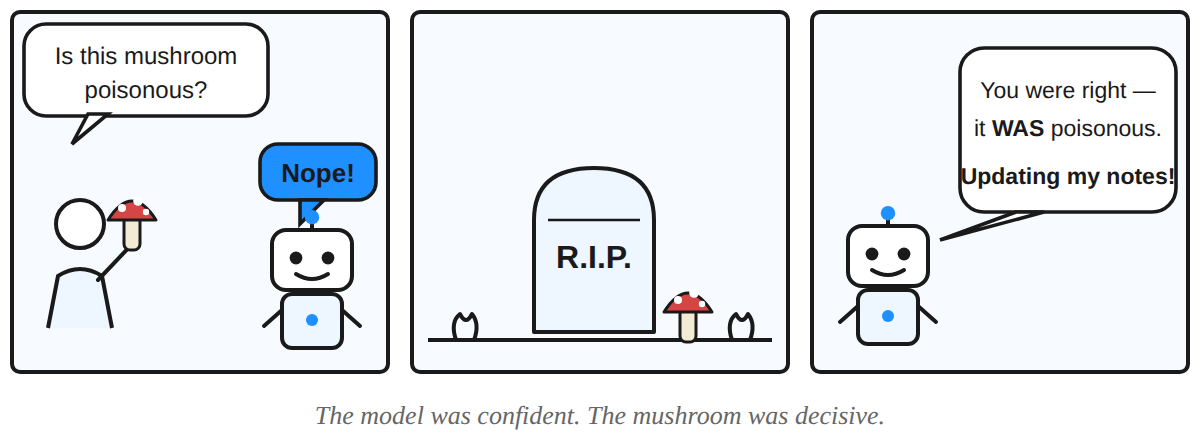
The model was confident. The mushroom was decisive.
The model you rent. The trust you build. Whoever engineers the layer around the model — grounding, evals, oversight — is the one who actually ships.
Until next month,
Raj Lal
Founder & CEO, ANCI AI (formerly TEAMCAL AI)
One ask: tell me the last time AI was confidently wrong in your world — and where you'd put the human checkpoint to catch it next time. I read every reply — and if yours makes next month's issue, there's a free Banksy tee in it for you.
The Takeaway
The most dangerous AI failure isn't being wrong — it's being wrong fluently, so everyone stops checking.
The fix was never a smarter model: it's grounding, evaluation, transparency, and a human at the commit point.
AI Edge for Leaders · Issue 07 · July 2026
Get AI scheduling insights, product news, and Bay Area community updates delivered to your inbox.
No spam. Unsubscribe anytime.