
The AI Mirage · Economics · July 2026
The Cost of Trust
Every layer that makes AI reliable — grounding, evaluation, verification, human review — adds money, latency, and effort. How much reliability to buy is a budget decision, not a technical one.
Read the earlier articles in this issue and the prescription sounds almost simple: ground the model, build evals, add verification, keep a human in the loop. Each is the right move. But strung together they quietly describe a system several times more expensive, slower, and harder to run than the naked model call that dazzled everyone in the demo. Trust, it turns out, has a price — paid in compute, in milliseconds, and in engineering and human hours — and someone has to decide how much of it to buy. This is the article the technical features imply but rarely say out loud: reliability is not a feature you switch on. It's a budget you allocate, and allocating it well is an executive skill.
01 — The Hidden InvoiceTrust is a line item, not a default
The demo that won the budget priced exactly one thing: a single call to the model. That number is small and getting smaller, which is why "AI is cheap" became conventional wisdom. But a trusted answer isn't one model call — it's a pipeline. To ground the answer you run a retrieval step and feed extra context into the model, which means more tokens per query. To verify it you often run a second model pass. To know your error rate you run and maintain an eval suite. To catch the high-stakes failures you pay a human to review. Each layer is defensible on its own; together they can multiply the cost of a "reliable" answer to several times — sometimes an order of magnitude beyond — the bare model call everyone benchmarked.
None of this is an argument against the layers. It's an argument against being surprised by them — because surprise is what kills projects at the worst moment. A pilot gets greenlit on demo economics, then hits production, and the true cost of doing it responsibly suddenly appears. Now the project is over budget, and the tempting fix is to strip out the "expensive" parts — the verification, the review — which are precisely the parts that made it trustworthy. The invoice was always going to come. Leaders who read it up front make sober choices; leaders who discover it late make dangerous ones under pressure.
This is the real reason the headline "AI is getting cheaper" is so misleading for planning purposes. Model inference prices genuinely are collapsing, and they'll keep falling. But the model call was never the expensive part of a trustworthy system, so making it cheaper barely moves the total. The costs that dominate a production deployment — building and maintaining the retrieval pipeline, running evals, staffing reviewers, monitoring in production — are largely human and operational, and those don't fall on the same curve as tokens. A leader who budgets from the falling model price will consistently under-fund the parts that actually cost money, and consistently be surprised. The right mental model is total cost of ownership, the same discipline you'd apply to any system, not the sticker price of one component.
02 — The Three CurrenciesWhat you actually pay in
Trust is billed in three separate currencies, and a use case can be constrained by any one of them. Seeing them apart is what lets you make deliberate trade-offs instead of blunt ones.
The first currency is money — the tokens, compute, licenses, and infrastructure each layer consumes. Grounding adds retrieval and context tokens; a verification pass can double your inference bill by running the model twice. The second is latency. Every layer you add sits between the user's question and the answer, and reliability steps are often serial: retrieve, then generate, then verify. A response that took half a second raw can take several seconds trusted — and in a customer-facing product, seconds are conversions lost. The third is engineering and human time — the up-front cost to build the pipeline and the ongoing cost to run it, monitor it, and, for high tiers, staff the human reviewers. This last one, human review, is uniquely expensive because it costs in all three currencies at once and, crucially, doesn't scale: doubling volume doubles the review bill in a way that compute never does.
03 — The Trade-OffFast, cheap, reliable — pick two
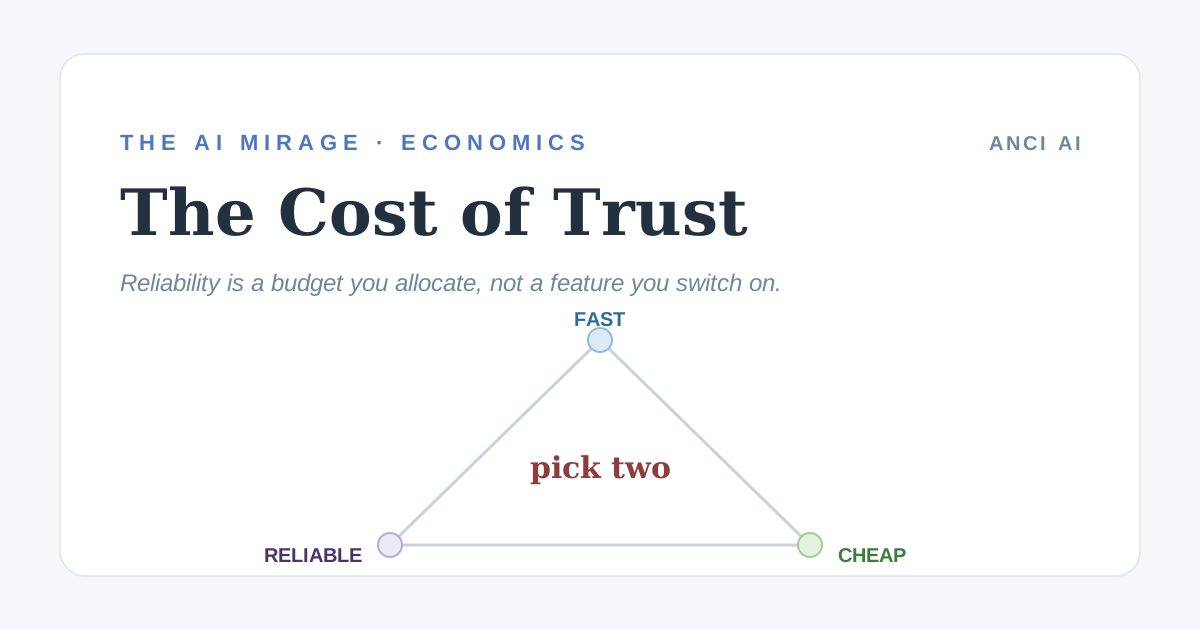
Because trust draws on money and latency, it collides directly with the two things every product also wants: to be cheap and to be fast. This produces a genuine trilemma. You can have a reliable answer quickly if you throw money at it; a reliable answer cheaply if you accept it's slow; a fast, cheap answer if you accept it's less reliable. What you cannot do is maximize all three at once. Every AI product lives somewhere inside this triangle, and pretending otherwise just means the trade-off is being made by accident instead of on purpose.
The strategic freedom here is that different use cases can sit in different corners on purpose. An internal tool can happily be fast and cheap at the expense of reliability, because a human catches the errors. A customer-facing financial answer must be reliable and fast, and you simply pay for it. A batch process that runs overnight can be reliable and cheap, because nobody's waiting — you trade latency you don't need for cost you'd rather save. The mistake isn't landing in a corner; it's landing there blindly, discovering too late that you optimized for cost on the one system where reliability was the whole point.
The latency corner deserves special attention, because it's the one leaders underweight. Reliability layers are often serial — the system must finish retrieving before it can generate, and finish generating before it can verify — so each safety step you add is time the user spends waiting. In an interactive product, that wait is not a technicality; it's a business metric. Research on web experiences has long shown that every added second of delay measurably erodes engagement and conversion. So the verification pass that makes an answer safer can, if handled naively, make the product worse in a way that shows up in revenue. The sophisticated teams hide this cost with engineering — streaming partial answers, running checks in parallel where possible, reserving the slow serial verification only for the high-stakes responses that truly need it — but that too is effort, which is to say, cost. There is no free reliability; there is only reliability whose price you've decided to pay cleverly.
04 — The AllocationSpend where the failure would hurt
So how much trust should you buy? The answer is the through-line of this entire issue: as much as the cost of being wrong justifies, and no more. The right investment in reliability for any use case is set by the size of the failure it prevents. Spend heavily to make a low-stakes tool bulletproof and you've wasted money; spend lightly on a high-stakes one and you've bought a lawsuit. The discipline is to line up the cost of trust against the cost of the failure, tier by tier.
Two numbers frame every decision. The first is the cost of buying trust — the money, latency, and effort of the layers you'd add. The second, which teams routinely forget, is the cost of the failure you're preventing: the refund and the reputational hit of a wrong customer answer, the fine and the lawsuit of a bad regulated one, the churn of a viral screenshot. Reliability spending is an insurance calculation. Nobody insures a paperclip; everybody insures a factory. When the failure is cheap and recoverable, buy little trust and move fast. When the failure is expensive or irreversible, the trust layers aren't overhead — they're the cheapest thing in the equation, because the disaster they prevent dwarfs their cost. The organizations that get this right aren't the ones that spend the most on AI reliability or the least. They're the ones whose spend tracks the stakes — generous where a failure would be ruinous, frugal where it would be trivial.
There's a second-order benefit to framing it this way that helps sell the spend internally. When reliability is presented as "extra cost," it always loses the argument to the version without it, which looks cheaper on the spreadsheet. When it's presented as insurance against a quantified failure, the conversation changes entirely — because now you're comparing the cost of the trust layers against the very real, sometimes enormous, cost of the incident they prevent. A few thousand dollars a month of verification and review is trivial next to a regulatory fine, a class of refunded customers, or the reputational cost of a viral failure. Making that comparison explicit is how a reliability budget stops being seen as a tax on innovation and starts being seen as what it is: the premium that lets you deploy at all in the tiers where deploying blind would be reckless.
The question the CFO should ask
Not "why does this AI feature cost more than the model call?" but "does our reliability spend on each use case match what a failure there would actually cost us?" A yes means you're buying insurance. A mismatch — either direction — means you're wasting money or courting disaster.
The TakeawayReliability is a budget, not a button
Everything that makes AI trustworthy costs something — money in compute, time in latency, and effort in engineering and human review — and pretending otherwise is how a pilot greenlit on demo economics becomes a product that strips out its own safety to hit budget. Trust is billed in three currencies and competes directly with speed and cost, so every use case sits somewhere in the fast-cheap-reliable trilemma whether you choose it or not. Treat reliability as insurance: buy it in proportion to what a failure would cost, generous where the downside is ruinous and frugal where it's trivial. The winning organizations don't spend the most on trust or the least — they spend it exactly where the stakes are.
From ANCI AI
Reliability priced into the architecture, not bolted on after
ANCI builds agents with the trust stack designed in from day one — grounding, verification, and human checkpoints dialed to each use case's tier, so you pay for exactly the reliability the stakes justify and no more. The invoice is on the table before the pilot, not after it.
Explore ANCI
Sources: Cost structure of retrieval-augmented and verified LLM pipelines (added tokens, second-pass inference, serving/monitoring infrastructure); latency characteristics of serial reliability steps; economics of human-in-the-loop review; risk-proportionate control principles consistent with the EU AI Act and NIST AI RMF.
Article 9 of 10 · The AI Mirage · AI Edge for Leaders.