

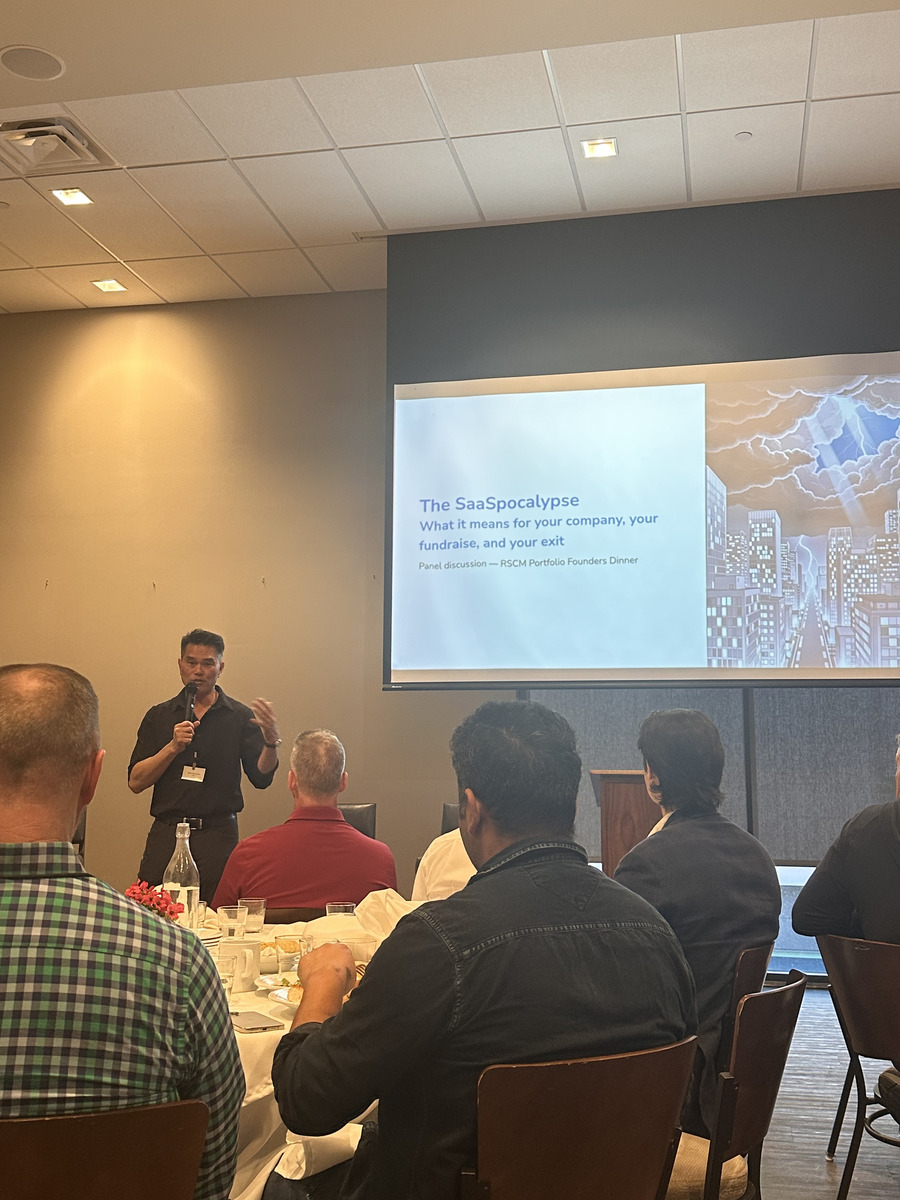
John Eng opened his keynote with one word on the screen: SaaSpocalypse. It was meant to land hard, and it did.
John is a Funding Ecosystem Partner with 25 years in B2B marketing and partnerships leadership across Microsoft, LinkedIn, and Parallels. His argument was not that SaaS is dead. His argument was that the rules used to evaluate, capitalize, and exit a software company have all changed inside an eighteen-month window, and most founders are still operating on the 2023 playbook.
He broke it into three pillars. What this moment means for your company, what it means for your fundraise, and what it means for your exit. Each one carries its own rewrite. Together they explain why some companies will be acquired this year at premium multiples and others will quietly disappear.
Pillar 01 · Strategy What it means for your company
The strategic reset comes first because everything else depends on it.
Foundation labs are eating horizontal categories. Harvey, the legal AI darling, took a direct hit when foundation labs released legal-tuned features. Monday.com, in horizontal project management, took a hit. The pattern is consistent: large, generic, horizontal categories are being absorbed into foundation-lab-native features at a pace founders cannot outrun.
Vertical is different. A vertical AI play in a niche industry is unlikely to be entered by a foundation lab. Anthropic is not going to ship an art gallery operations agent. OpenAI is not building a property management workflow. The vertical is too small, too specific, too unprofitable for them to bother. That is the protected ground.
For a company in the middle of this shift, three questions matter:
- Are we horizontal or vertical? Be honest. "Horizontal sold into a vertical" is still horizontal.
- Do we have the three incumbent assets? Customer relationships, proprietary data, persona-level pain knowledge. These were nice-to-haves in the SaaS era. They are the moat now.
- Have we shipped at least one agent? If you have been operating for three or more years, the answer should be yes. Investors will ask in the first diligence call, and "we have a plan" is the wrong answer.
Pillar 02 · Fundraise What it means for your fundraise
The new rubric is short, mechanical, and runs through an AI model before a human ever reads your deck.
The investor opening your PDF is not reading it. They are running it through Claude or ChatGPT with a structured prompt that scores:
- How defensible is the moat?
- Who are the traditional competitors, and how are they responding to AI?
- Could this be vibe-coded on a weekend by a competent founder?
- Is there proprietary data underneath the product?
- Is the company a system of record, a system of action, or both?
If the deck cannot answer those questions, the conversation does not advance. There is no follow-up meeting. There is no curious second look. The deck scored low, and the pipeline moves to the next one.
The implication is uncomfortable. The first reader of a 2026 fundraising deck is not a human looking for a story. It is a model looking for evidence. Stories still matter, but they only get read if the rubric clears.
The metric expectations have also moved. New ARR growth, the old signal, has been replaced by MRR durability and agent traction. Investors are not asking "how fast are you growing." They are asking three different questions: are you losing seats, is this product something a customer could rebuild on Claude this weekend, and where are your agents.
That last question is the one most founders are unprepared for. If you have an installed base, an investor expects you to have shipped at least one agent already. The logic is direct: you have the customer, you have the data, you have the right to win. If you have not used those assets, the assumption is that you do not understand the moment.
Capital is interested. Capital is not deploying. Most of the early-stage allocation that did get deployed in Q1 went to the top twenty percent of deals. Everyone else split the remainder. Funds are judicious in a way they were not eighteen months ago. The bar moved. The time-to-check stretched.
Pillar 03 · Exit What it means for your exit
IPO is off the table for most companies. The revenue bar is too high, the public market appetite is too thin, and the cost of being public has compounded.
The default exit is M&A. There is a lot of acquirer capital and a lot of acquirer appetite, but acquirers are extremely judicious about valuation. Wall Street price-to-earnings ratios on tech have dropped from roughly 30 to 22, which is below the S&P 500. The fastest-growing software businesses are trading at lower multiples than industrial companies. The strangest signal in the market right now, and it tells founders something important: nobody is going to overpay.
The clearest framework of the night was on a single slide titled "The exit landscape is shifting." Two columns. What acquirers are paying premiums for today, and what they are discounting.
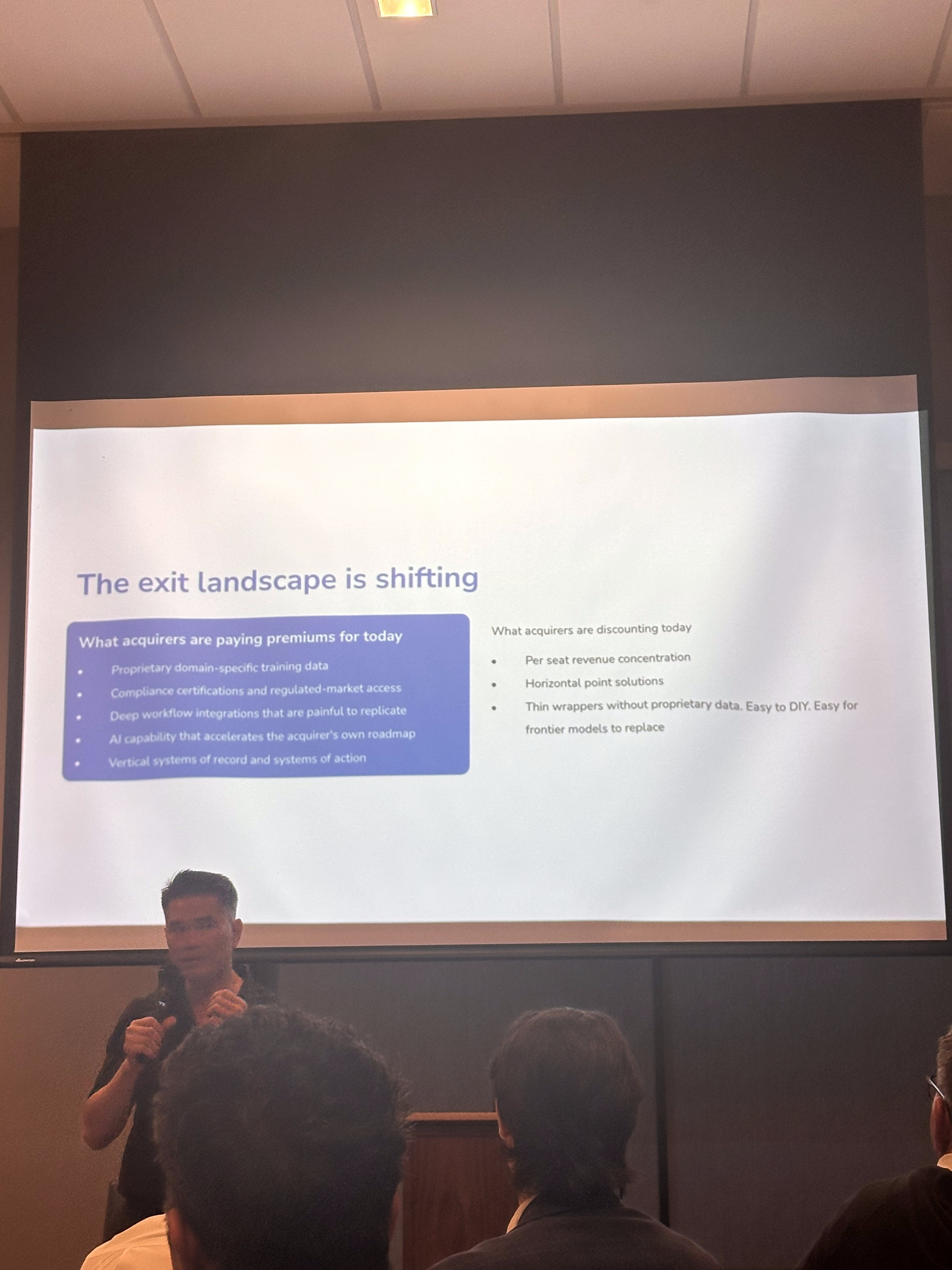
Read those two columns next to each other and the strategic playbook for the next twelve months is obvious. Build into the premium list. Out of the discount list. The companies that finish 2026 in the premium column will be acquired at multiples that return their funds. The companies that finish in the discount column will not be acquired at all, or will be acquired for parts.
The Underwriting Thesis The Goldilocks Window
There is one strategic insight that runs underneath the company, fundraise, and exit conversations and explains why this particular window is unusually open right now.
That window is the leverage point. It is the reason MRR is growing for companies that have shipped agents, why investors are asking about agents in diligence, and why acquirers are willing to pay premium multiples for proprietary data even as the broader tech P/E compresses. The window underwrites the math.
The window will close. When it does, agent-on-agent competition will compress margins back toward, and likely below, classic SaaS margins. Companies that did not use the window to build proprietary data, regulated-market access, and workflow depth will not raise the next round, and will not be acquired.
The Playbook What to do this quarter
A short checklist for leadership teams sitting inside the SaaSpocalypse:
- Run your own deck through Claude using the new rubric. Score yourself before the investor does. If you cannot answer the defensibility, moat, and vibe-code questions, fix the company before fixing the deck.
- Pick the vertical you can defend. If the pitch is horizontal, the rubric will score you against the foundation labs.
- Ship at least one agent if you have been operating three or more years. The first question in the diligence call will be about it. Agents that replace a role end-to-end carry more weight than copilots that help.
- Anchor pricing to labor. If the role costs $X a year, the agent is priced at twenty to thirty percent of $X. Per seat pricing is on the discount list.
- Build into the premium column. Proprietary data, compliance certifications, deep workflow integrations, agent-accelerated roadmap, system of record plus system of action. That is the acquirer checklist, and it is the same checklist that gets the next round.
- Treat the next eighteen months as the Goldilocks Window. Use it to build defensibility. It will not be open in 2028.
The Close
The SaaSpocalypse is not the end of software. It is the transition between the SaaS era and whatever comes after.
The companies that walk through it will look very different in twenty-four months. They will have fewer seats and more agents, higher ACV and lower headcount inside the customer, and a margin profile that rewards data depth instead of distribution scale. They will be the ones acquirers fight over.
The companies that do not walk through it will be the ones in the discount column. Thin wrappers, horizontal point solutions, per-seat revenue concentration, easy for the frontier model to replace.
The deck is not being read by the person you think it is being read by. The acquirer is not paying for what you think they are paying for. The window is not as wide as it feels.